
2026 Market Outlook
The following 2026 Market Outlook is authored by Brian Andrew, Chief Investment Officer at Merit Financial Group, LLC, an SEC registered investment adviser. Mr. Andrew, formerly Executive Vice President at Johnson Financial Group, oversees Merit’s investment department and leads asset allocation decision-making for client portfolios.
As we expand our content offerings this year, we’re excited to share more insights from our investment team. Mr. Andrew’s market analysis and economic perspectives directly inform how we manage client assets through various market cycles, making his outlook particularly relevant for understanding our investment approach.
Merit Financial Advisors specializes in serving affluent and emerging affluent families with comprehensive wealth management solutions.
For additional market insights and video commentary from Mr. Andrew, visit: https://meritfinancialadvisors.com/blog/2026-market-outlook/
After two strong years in financial markets, 2026 begins at a moment of meaningful transition.
The economic environment remains constructive, but many forces that propelled returns in 2023–2025 are evolving. This year could potentially reward investors who stay balanced, disciplined, and focused on companies and asset classes with durable fundamentals.
In this report, we summarize what shaped 2025 and highlight the themes and opportunities we believe will be most important in the year ahead.
2025 in Review: Strong Performance with a Broader Foundation
Despite political turnover, fluctuating tariff announcements, and persistent debate about the Federal Reserve’s next steps, U.S. and global markets delivered surprisingly strong results in 2025. U.S. equities gained nearly 18%, while international developed and emerging markets rose more than 30%, supported by easing inflation, improving global fiscal spending, and strong demand for technology infrastructure.
Artificial intelligence remained the dominant story, but leadership broadened. Semiconductor companies, memory providers, utilities, and other companies tied directly to AI infrastructure saw strong demand, reflecting the enormous capital investment cycle underway.
Fixed income also stabilized meaningfully as the Fed shifted toward rate cuts late in the year. Yield levels fell from their 2024 peaks, and a steepening yield curve created a healthier backdrop for bonds. Meanwhile, private markets—including private credit, infrastructure, and real assets—saw improved transaction activity, better valuations in some sectors, and strengthening fundamentals.
Key Themes Shaping the 2026 Landscape
AI Transitions from Infrastructure Buildout to Earnings Impact
Despite political turnover, fluctuating tariff announcements, and persistent debate about the Federal Reserve’s next steps, U.S. and global markets delivered surprisingly strong results in 2025. U.S. equities gained nearly 18%, while international developed and emerging markets rose more than 30%, supported by easing inflation, improving global fiscal spending, and strong demand for technology infrastructure.
A Federal Reserve Near the End of Its Cutting Cycle
The Federal Reserve began easing in late 2025, and modest additional cuts are expected in 2026. However, structural deficits, rising Treasury issuance, and sticky inflation may keep long-term rates higher than in past cycles. This environment favors income-oriented fixed-income strategies, diversified yield exposure, and active management.
Equities Enter a More Earnings-Driven Market
With valuations above long-term averages, 2026 equity performance will depend far more on earnings growth. Companies with strong top-line momentum, healthy margins, and disciplined balance sheets are best positioned. International markets offer compelling value. However because of their outperformance last year, mostly resulting from dollar weakness will need to see real earnings growth to keep performance up. Broader sector leadership is also likely as fiscal spending and monetary easing support global demand.
Volatility Will Create Opportunity, Not Disorder
Investor leverage reached historic highs in 2025, contributing to the potential for more frequent market swings. While uncomfortable, volatility provides opportunities to add quality assets at better entry points. Volatility reflects normal late-cycle dynamics rather than fundamental stress. Because it is a mid-term election year, we may also see party differences highlighted and that too could cause volatility. The Federal government’s foreign policy along with global geo-politics will cause volatility and potentially a shift in longer term secular themes affecting market sectors such as defense, health care and banking.
Asset Class Outlook for 2026
Equities
We maintain a constructive but selective view. With more than 40% of the S&P 500 Index represented by the largest 10 companies, the diversity of equity portfolios are more important this year. We believe that companies with sustainable earnings, durable competitive advantages, and global diversification remain well-positioned. AI continues to offer meaningful opportunity, but fundamentals—not speculative growth—could determine this year’s winners.
Fixed Income
Elevated yields make 2026 one of the most attractive fixed-income environments in years. Intermediate-term Treasuries, high-quality corporates, and securitized credit offer compelling combinations of yield, stability, and diversification. It is important to maintain good credit quality and no more than an intermediate average maturity in portfolios to take advantage of the best parts of the fixed income markets. For municipal bond buyers, a longer average maturity may make sense as municipal yields offer attractive yields for highly taxed investors.
Alternatives
Alternatives remain essential in diversified portfolios. Particularly for those clients looking to diversify away from a more expensive public equity market or looking for additional yield not available in public bond markets. Private credit benefits from higher yields and renewed initial public offerings transaction activity in 2026 should benefit private equity funds. Infrastructure stands out as a long-duration, inflation-sensitive asset class supported by rising global investment needs. Real assets continue to provide diversification and income durability. The metals market certainly saw big gains in 2025 so investors should be careful when starting new positions. Volatility could provide opportunity to find points to add to existing positions.
Positioning for 2026
- Favor U.S. equities but maintain global exposure.
- Balance growth participation with risk management.
- Stay disciplined with AI and technology allocations.
- Use volatility as an opportunity rather than a deterrent.
Bottom Line: 2026 is a year of inflection—a shift from expectation to execution. Earnings, interest-rate policy, and the next phase of AI adoption will shape markets, but long-term investors who stay diversified, disciplined, and focused on quality are well-positioned for success.
Disclosure
This material is for general information only and is not intended to provide specific advice or recommendations for any individual. There is no assurance the views or strategies discussed are suitable for all investors or will yield positive outcomes. Investing involves risks including possible loss of principal. Any company names noted herein are for educational purposes only.
All information is believed to be from reliable sources; however we make no representation as to its completeness or accuracy. All economic and performance data is historical and not indicative of future results. Market indices discussed are unmanaged. Investors cannot invest in unmanaged indices. Additional risks are associated with international investing, such as currency fluctuations, political and economic instability and differences in accounting standards.
Investing in securities in emerging markets involves special risks due to specific factors such as increased volatility, currency fluctuations and differences in auditing and other financial standards. Securities in emerging markets are volatile and can decline significantly in response to adverse issuer, political, regulatory, market, or economic developments.
An index is a statistical measure of change in an economy or a securities market. In the case of financial markets, an index is an imaginary portfolio of securities representing a particular market or a portion of it. Each index has its own calculation methodology and is usually expressed in terms of a change from a base value. Thus, the percentage change is more important than the actual numeric value. An investment cannot be made directly into an index.
Investing in fixed income securities involves credit and interest rate risk. When interest rates rise, bond prices generally fall. Investing in commodities may involve greater volatility and is not suitable for all investors. Investing in a non-diversified fund that concentrates holdings into fewer securities or industries involves greater risk than investing in a more diversified fund. The equity securities of small companies may not be traded as often as equity securities of large companies so they may be difficult or impossible to sell. Neither diversification nor asset allocation assure a profit or protect against a loss in declining markets. Past performance is not an indicator of future results.
Financial Planning offered through Reason Financial, a state Registered Investment Advisor. Investment advice offered through Merit Financial Group, LLC an SEC Registered Investment Advisor. Merit Financial Group and Reason Financial are separate entities. Tax related services offered through Reason Tax Group. Reason Tax Group is a separate legal entity and not affiliated with Merit Financial Group, LLC. Sean P. Storck CA Insurance Lic#OF25995 and Steven W. Pollock CA Insurance Lic#OE98073
Copyright © 2026 Reason Financial all rights reserved.
Continue Reading
3rd Quarter 2026 – Economic and Market Update
Q2 2026 in review: the S&P 500’s best quarter since 2020, oil’s round trip from $114 back to $70, a 4.2% CPI print that would not quit, and a new Fed chair who took 2026 rate cuts off the table — plus what a 15% quarter means for the allocation you actually own.
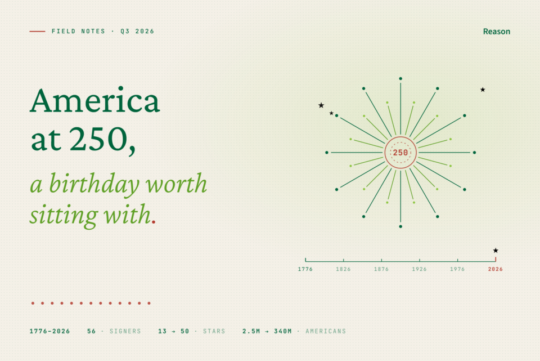
America at 250: A Birthday Worth Sitting With for a Moment
The United States just turned 250 — and the story reads surprisingly well as a series of 50-year check-ins. Founding-era population the size of San Diego County, two presidents with impeccable dramatic timing, a telephone demo in Philadelphia, quarters you’re still finding in your change — and one compounding machine that started counting in 1926.
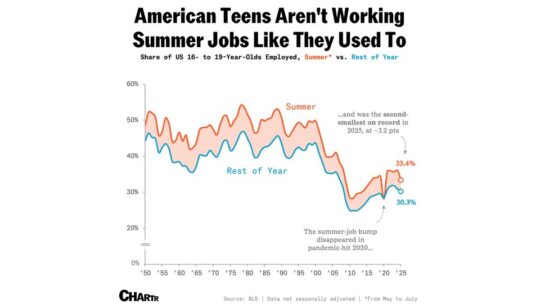
American Teens Aren’t Working Summer Jobs Like They Used To
This Chartr line chart tracks the share of U.S. 16- to 19-year-olds who were employed from 1950 through 2025, split…