
3rd Quarter 2026 – Economic and Market Update
AN ECONOMIC AND MARKET UPDATE
Q3 2026 / April 1 – June 30, 2026
EXECUTIVE SUMMARY
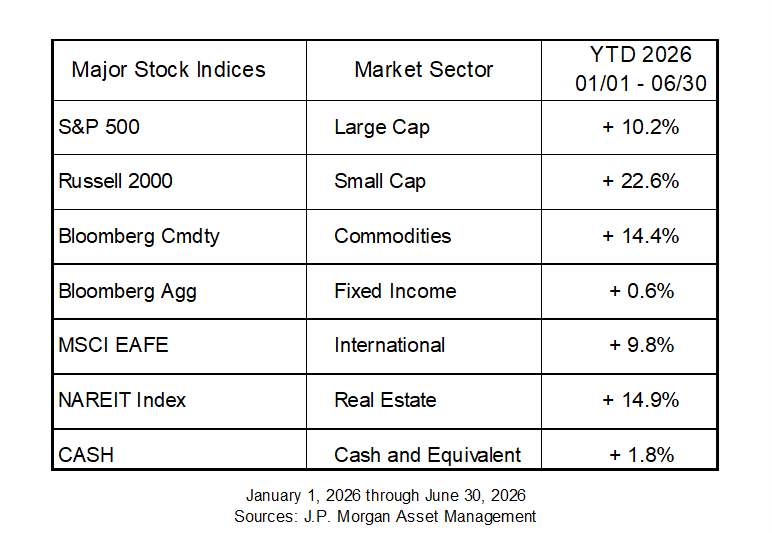
If the first quarter of 2026 was about shock, the second was about relief. The Iran conflict that upended markets in late February – closing the Strait of Hormuz, driving crude oil to a 46-month high of $112.84 on April 7th gave way, on June 17th, to an interim agreement that reopened the Strait and let oil, gold, and a fair amount of investor anxiety come back down to earth. The S&P 500 responded with a 15.2% quarter, its best since the pandemic rebound of 2020, and by June 30 the index sat at 7,499. That is the kind of round trip that looks obvious in hindsight and felt anything but obvious in the moment, which is precisely why we spent the quarter rebalancing rather than reacting.
The defining commodity story of the quarter ran in reverse to the prior quarter. West Texas Intermediate crude, which entered 2026 near $57 and spiked above $102 as the conflict escalated in March, peaked at $114.58 in the first week of April and then spent the rest of the quarter unwinding — first slowly, as workarounds circumventing the Strait grew, and then quickly after the June agreement, finishing June at roughly $70 a barrel, a decline of about a third from where the quarter began. Consumers felt the peak before they felt the relief: the national average for a gallon of regular hit $4.56 by Memorial Day weekend, a four-year high, and May’s average of $4.48 ranked as one of the highest months on record.
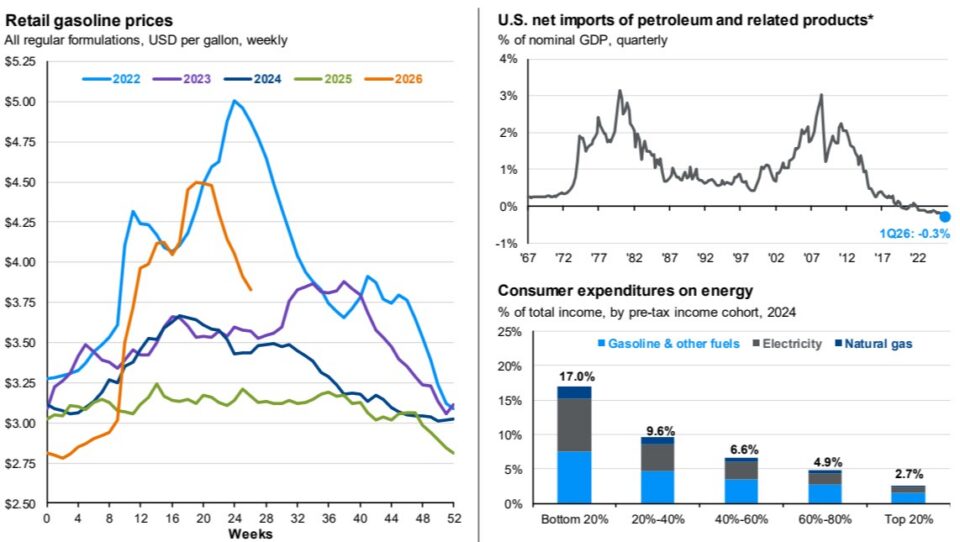
Source: J.P. Morgan Asset Management; Department of Energy; BEA; BLS, Guide to the Markets – U.S. Data are as of June 30, 2026
Gold told the same story from the other side. Having ridden investor anxiety to record highs around $5,400 an ounce in late January, it fell roughly 15% during the second quarter — its worst quarter since 2013 — to close June near $4,008. When the hedges retreat and the risk assets rally, that is the market’s way of saying the emergency is being downgraded to a situation.
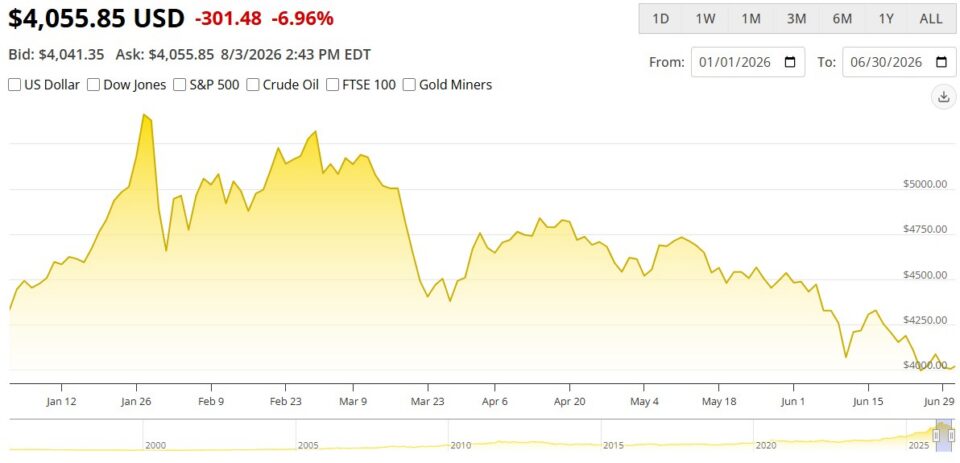
Source: JM Bullion, data are as of June 30, 2026
As we have seen over the brief time the war with Iran has transpired there is no such thing, yet, as a done deal. Both highlighted commodities have been highly volatile. Gold is more of a fear measure and has little impact on the daily prices most of us pay for anything other than jewelry. On the other hand, oil has a significant impact on inflation as we will see.
INFLATION’S LONG TAIL: A 4.2% HEADLINE AND A NEW HAND AT THE FED
Oil prices came down; the inflation they caused has not, at least not yet. The May CPI reading of 4.2% was the hottest in three years, and the May PCE index (the Fed’s preferred gauge) ran at 4.1%, with core PCE at 3.4%. The distinction that matters is between the headline and the core: strip out energy’s 23.5% year-over-year surge and underlying inflation, at 2.9% core CPI, looks far less alarming. The question, as it was in 2022, is whether an energy shock stays an energy shock or seeps into everything else — airfares, shipping, services — before it fades.
The Federal Reserve spent the quarter refusing to guess. Rates were held at 3.50%–3.75% in both April and June, but the two meetings could hardly have felt more different.
April was Jerome Powell’s final press conference as Chair, and he left the way he governed, carefully: “In the near term, higher energy prices will push up overall inflation,” he noted, adding later in the press conference, “If we need to hike, we will certainly signal that, and we will certainly do it.”
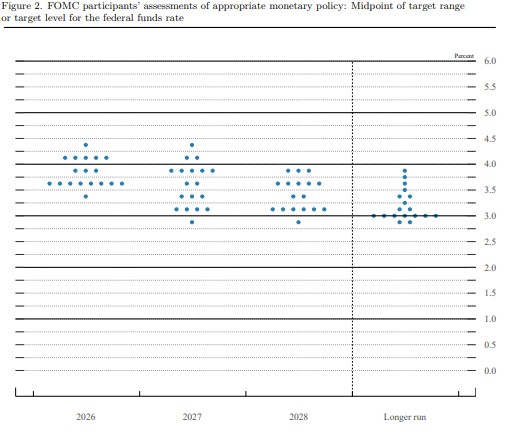
Source: Federal Reserve Summary of Economic Projections, data are as of June 17, 2026
June belonged to his successor, Kevin Warsh, who trimmed the policy statement, provided less forward guidance, and removed his vote on interest rate direction from the published dot plot, pictured above. His first meeting message was unmistakable: “Members of the FOMC are unambiguous and unanimous: This Committee will deliver price stability.” Rate cuts, which have been discussed for a long time, appear to be off the table for the remainder of 2026 with only one member indicating a rate reduction for 2026. Although Chairman Warsh removed his dot from the plot, it is easy to infer from his strong statement regarding price stability that he did not land on the side of a cut. It is an interesting time to be a Fed watcher, and we say that as people who have watched the Fed for a long time.
THE STOCK MARKET: A CHANGING OF THE GUARD
Here is the statistic we keep coming back to: the S&P 500 gained 15.2% in the second quarter, its twelfth-best quarter since 1950, and the Magnificent 7, the seven mega-cap technology names that accounted for nearly half of the market’s return in 2025, contributed almost none of it. Through June 30 the Mag 7 are roughly flat for the year while the other 493 stocks in the index are up about 15%. Leadership passed to semiconductors, industrials, and. most encouraging to us, the parts of the market that had been left behind: small caps returned 21.5% for the quarter and 22.6% year-to-date, emerging markets lead all major asset classes at 24.0%, international developed stocks are up 9.8%, and real estate investment trusts returned 10.7% in the quarter.
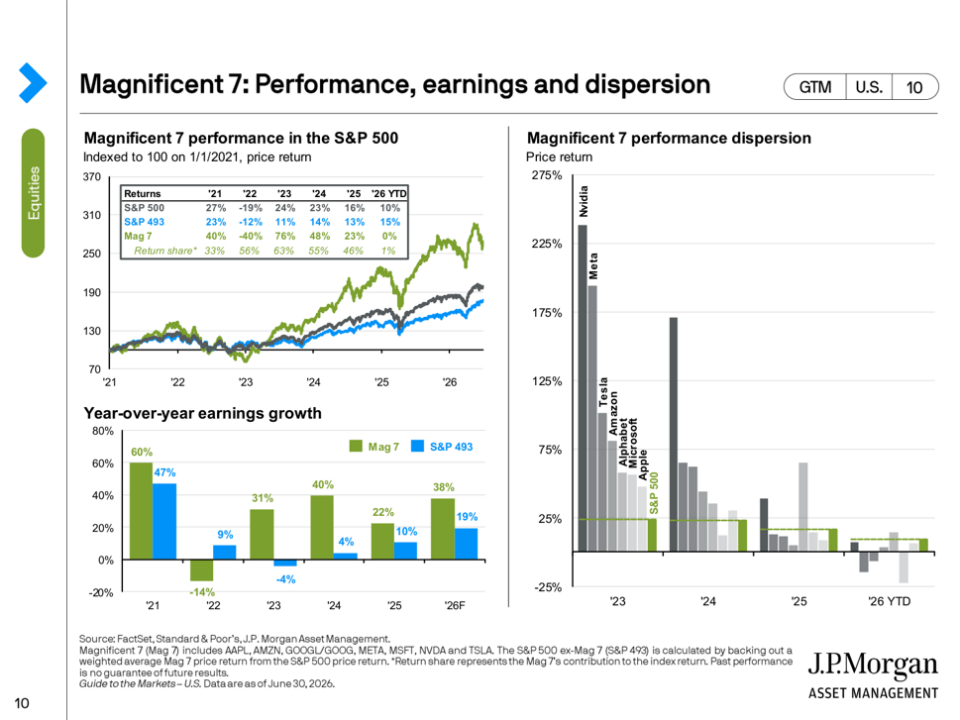
Source: J.P. Morgan Asset Management, Guide to the Markets – U.S. Data are as of June 30, 2026
A broadening market is a healthier market, but it is not a cheap one. The index ended June at 20.4 times forward earnings, and the top ten names still represent roughly 40% of its value. Earnings growth, not multiple expansion, has done the work in 2026 (which is the good news) but concentration at these levels means the index and a diversified portfolio are two increasingly different things.
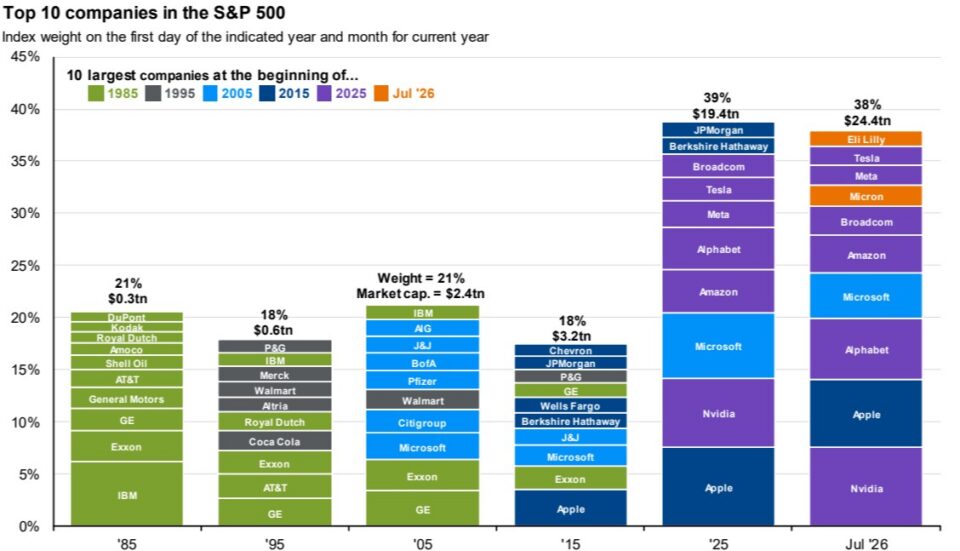
Source: Bloomberg, FactSet, J.P. Morgan Asset Management, Guide to the Markets – U.S. Data are as of June 30, 2026
In the graph above you can see what concentration looks like over the past 40 years. We have moved from concentration in the top companies of around 20%, to the last several years where concentration has doubled to near 40%. This amplifies the difficulty and importance of diversification. The significance of diversification, and not being over-leveraged, was perfectly illustrated in the recent fall of the Situational Awareness AI hedge fund. Leopold Aschenbrenner amassed a large hedge fund over the last couple of years betting on AI with heavy concentration in investments and doubling down on his calls. With the struggles of a variety of AI companies in recent months his fund was crushed resulting in its sale to another fund manager, Ken Griffin of Citadel. A lack of diversification will get you someday, you just don’t know when the turn of the wheel will come around to it.
INVESTMENT STRATEGY
The strategists we follow most closely arrived, from different directions, at the same word: rebalance. J.P. Morgan’s Dr. David Kelly argued in his May commentary that investors should consider “rebalancing away from mega-cap growth stocks and towards areas with less lofty valuations including U.S. value stocks, international equities and high-quality fixed income.”
Brian Andrew, Chief Investment Officer at Merit Financial Group, struck the same chord on our June advisor call, noting that after a twelve-month run that carried balanced portfolios up roughly 20%, equity allocations across client portfolios had drifted meaningfully above their targets: “My word of caution would be think about rebalancing if you haven’t been thinking about rebalancing.” His longer-run theme is one we take seriously — that “we’re seeing an unraveling of the globalized world,” and that two decades of globalization-driven disinflation are reversing, which argues for broader diversification and a higher structural floor under interest rates. Merit’s investment team spent the quarter accordingly: trimming equity overweights back to target, favoring shorter-maturity bonds where starting yields, now above their post-2009 averages across nearly every fixed income sector, do the heavy lifting, and watching small and mid-cap stocks, which sit in their cheapest valuation range in a decade, as a candidate for additional allocation in the second half.
None of this is a prediction that the market’s run ends here. It is the observation that after a 15% quarter, the portfolio you have is probably not the portfolio you chose and that fixing that is the rare investment decision you can make without a crystal ball.
THE FINANCIAL PLANNING CORNER
- Rebalance on purpose and be tax-aware. If stocks have drifted well above your target after the past year’s gains, trim inside retirement accounts first, use specific tax lots in taxable accounts, and consider gifting appreciated shares to charity rather than selling them.
- Put cash and bonds back to work by their yields, not by rate forecasts. With the Fed on hold and cuts off the 2026 table, money markets, Treasury bills, and high-quality bonds are all paying real income. Build the ladder for your timeline instead of waiting for a better entry.
- Check your estimated tax payments before September 15. Higher rates cut both ways: the IRS underpayment penalty is pegged to short-term interest rates, which makes falling behind on quarterly estimates more expensive than it used to be.
- Revisit your long-term care plan. This quarter’s companion piece covers asset-based long-term care — including a tax provision that lets an old annuity fund care benefits. If you own an annuity you no longer have plans for, it is worth fifteen minutes of your attention.
TRUMP ACCOUNTS
Now is the time. If you have a child or grandchild that was born in 2025 through the present, opening an account is a no-brainer as you receive $1,000 seed money contribution paid for by you and me. I mean the government.
If you have a child or grandchild born prior to 2025, this is probably still a great idea, they just do not get the $1,000 seed money paid for by the taxpayers.
Contributions are capped at $5,000/year. However, it is amazing how large $5,000/year can grow too when given enough time. The money will grow in a tax-deferred, IRA-style structure between initial funding and retirement.
The best source for information and account opening is at Trumpaccounts.gov. If you don’t love the name, call it something else. We live in a time where Social Security is scheduled to initiate benefit cuts sometime in the next 8 years. The greatest strategic method to combat this is to start saving early and often. The best time to plant a tree was twenty years ago, the second-best time is today. Plant the tree of fiscal security for your children and grandchildren if it is possible for you to do so. Start small if you have too by putting in the birthday money they receive.
The second batch of good news, California now conforms to Trump account law. This isn’t a good deal, it is a great deal. California non-conformity was a structural problem that has been removed, which really shows how good this really is. California conforming to Federal law is akin to pigs taking flight, it just does not happen. There are real conversations be to had regarding Trump Account funding and/or 529 Plan funding. We are happy to discuss the various strategies with you.
As always, our desire is to help you make rational, informed and well-reasoned decisions, and we thank you for your continued trust and support.
— Steve & Sean
SOURCES
- “Crude Oil Prices: West Texas Intermediate (WTI) – Cushing, Oklahoma.” FRED, Federal Reserve Bank of St. Louis, 29 July 2026, fred.stlouisfed.org/series/DCOILWTICO.
- “Motor Fuel Prices – May 2026.” Motor Fuel Prices – May 2026 | Bureau of Transportation Statistics, Bureau of Transportation Statistics, 2 June 2026, www.bts.gov/newsroom/motor-fuel-prices-may-2026-0.
- “April 29, 2026 Chair Powell’s Press Conference Final Page 1 of 28.” Federal Reserve Board – FOMC, 20 May 2026, www.federalreserve.gov/mediacenter/files/FOMCpresconf20260429.pdf.
- “June 17, 2026 Chairman Warsh’s Press Conference Final Page 1 of 21.” Federal Reserve Board – FOMC, 8 July 2026, www.federalreserve.gov/mediacenter/files/FOMCpresconf20260617.pdf.
- Gould, Hilarey. “What Happened at Kevin Warsh’s First Fed Meeting as Chair? 3 Key Takeaways from the June 2026 FOMC Decision.” J.P. Morgan Wealth Management, J.P. Morgan Chase, 18 June 2026, www.chase.com/personal/investments/learning-and-insights/article/kevin-warsh-june-2026-federal-reserve-meeting-key-takeaways.
- Kelly, David. “Quarter Days and the Economic Outlook.” Quarter Days and the Economic Outlook, J.P. Morgan Asset Management, 4 May 2026, am.jpmorgan.com/us/en/asset-management/adv/insights/market-insights/market-updates/notes-on-the-week-ahead/quarter-days-and-the-economic-outlook/.
- https://trumpaccounts.gov/
- “2026-26: California Conforms to Trump Account Treatment, Provides EV Rebates.” Spidell, 14 July 2026, spidell.com/news/flash-email/2026-26-california-conforms-to-trump-account-treatment-provides-ev-rebates/.
Disclosure
This material is for general information only and is not intended to provide specific advice or recommendations for any individual. There is no assurance the views or strategies discussed are suitable for all investors or will yield positive outcomes. Investing involves risks including possible loss of principal. Any company names noted herein are for educational purposes only.
All information is believed to be from reliable sources; however we make no representation as to its completeness or accuracy. All economic and performance data is historical and not indicative of future results. Market indices discussed are unmanaged. Investors cannot invest in unmanaged indices. Additional risks are associated with international investing, such as currency fluctuations, political and economic instability and differences in accounting standards.
Investing in securities in emerging markets involves special risks due to specific factors such as increased volatility, currency fluctuations and differences in auditing and other financial standards. Securities in emerging markets are volatile and can decline significantly in response to adverse issuer, political, regulatory, market, or economic developments.
An index is a statistical measure of change in an economy or a securities market. In the case of financial markets, an index is an imaginary portfolio of securities representing a particular market or a portion of it. Each index has its own calculation methodology and is usually expressed in terms of a change from a base value. Thus, the percentage change is more important than the actual numeric value. An investment cannot be made directly into an index.
Investing in fixed income securities involves credit and interest rate risk. When interest rates rise, bond prices generally fall. Investing in commodities may involve greater volatility and is not suitable for all investors. Investing in a non-diversified fund that concentrates holdings into fewer securities or industries involves greater risk than investing in a more diversified fund. The equity securities of small companies may not be traded as often as equity securities of large companies so they may be difficult or impossible to sell. Neither diversification nor asset allocation assure a profit or protect against a loss in declining markets. Past performance is not an indicator of future results.
Financial Planning offered through Reason Financial, a state Registered Investment Advisor. Investment advice offered through Merit Financial Group, LLC an SEC Registered Investment Advisor. Merit Financial Group and Reason Financial are separate entities. Tax related services offered through Reason Tax Group. Reason Tax Group is a separate legal entity and not affiliated with Merit Financial Group, LLC. Sean P. Storck CA Insurance Lic#OF25995 and Steven W. Pollock CA Insurance Lic#OE98073
Copyright © 2026 Reason Financial all rights reserved.
Continue Reading
America at 250: A Birthday Worth Sitting With for a Moment
The United States just turned 250 — and the story reads surprisingly well as a series of 50-year check-ins. Founding-era population the size of San Diego County, two presidents with impeccable dramatic timing, a telephone demo in Philadelphia, quarters you’re still finding in your change — and one compounding machine that started counting in 1926.
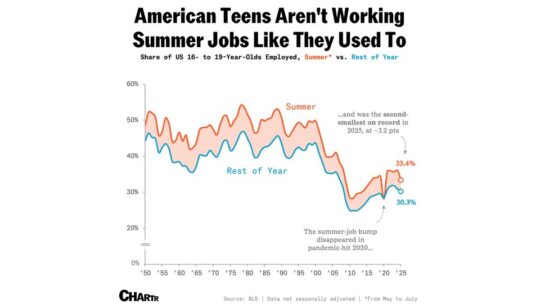
American Teens Aren’t Working Summer Jobs Like They Used To
This Chartr line chart tracks the share of U.S. 16- to 19-year-olds who were employed from 1950 through 2025, split…

Hybrid Long-Term Care: Coverage That Isn’t Wasted + Tax-Smart Way to Fund It
Long-term care keeps coming up in client conversations, usually when someone is helping a parent through it and starts thinking about their own plan. The good news is that the use-it-or-lose-it policy most people remember is no longer the only choice: asset-based coverage repositions an old annuity or idle cash into care benefits worth a multiple of what you put in, and a Pension Protection Act rule lets an annuity’s gains fund qualified care income-tax-free instead of coming out as ordinary income. We walk through how it works, a worked example, and who it fits (and doesn’t).