
1st Global Engages Dr. Harry M. Markowitz as Consultant and Advisor
 DALLAS, TX – March 17, 2010 – 1st Global, the wealth management and business development partner to leading CPA, tax and estate planning firms, announces that Dr. Harry M. Markowitz, Ph.D., recipient of the 1990 Nobel Memorial Prize in Economic Sciences for his dissertation on Modern Portfolio Theory(MPT), has been engaged as advisor to 1st Global’s Investment Management Solutions (IMS) investmentcommittee and as a consultant to 1st Global’s Investment Management Research Group (IMRG). In this role, Dr. Markowitz will draw on his ongoing research surrounding evolutions in portfolio efficiency. He will incorporate his fundamental work on MPT with the latest advancements in academic theory to advise 1st Global on asset allocation model development processes, innovations on risk and return measurement,investment strategies including integration of hedged, leveraged and illiquid investments in efficient portfolios, reviewing and composing research papers relevant to independent financial advisors, andmore.
“We are very pleased to be working with such an inspirational thought leader whose monumental work onmodern portfolio theory is still the foundation of portfolio design for institutional and retail investmentsciences after more than half a century,” said 1st Global CEO Tony Batman. “Dr. Markowitz’s very activeand passionate commitment to find new practical insights is inspiring. We are confident that through thispartnership, we will continue to enhance our powerful, open-architecture managed account platform (IMS)and enable affiliated 1st Global wealth managers to deliver the investment innovations needed to meet the evolving demands of their emerging affluent and high net worth clients in an ever increasing complex and risky world.”
About Harry M. Markowitz, Ph.D.
Dr. Markowitz is a Nobel Laureate and the father of Modern Portfolio Theory, studying the effects of investment and portfolio variability, return, and correlation. Famous for his work in economics, Dr.Markowitz has made equally significant strides in the field of technology. He was awarded the prestigious Von Neumann Prize in Operations Research Theory for his work in portfolio theory, sparse matrix techniques and the SIMSCRIPT programming language. Dr. Markowitz was also recently given the “Manof the Century” award by Pensions & Investments magazine for his life’s work in the field of investments.Dr. Markowitz currently divides his time between teaching as an adjunct professor at the Rady School ofManagement at the University of California at San Diego and consulting.
1st Global Capital Corp. is a member of FINRA and SIPC and is headquartered at 8150 N. CentralExpressway, Suite 500 in Dallas, Texas, 75206, (214) 265-1201. Investment advisory services offeredthrough 1st Global Advisors, Inc. Additional information about 1st Global is available via the Internet atwww.1stGlobal.com.© 2010 1st Global
Disclosure
This material is for general information only and is not intended to provide specific advice or recommendations for any individual. There is no assurance the views or strategies discussed are suitable for all investors or will yield positive outcomes. Investing involves risks including possible loss of principal. Any company names noted herein are for educational purposes only.
All information is believed to be from reliable sources; however we make no representation as to its completeness or accuracy. All economic and performance data is historical and not indicative of future results. Market indices discussed are unmanaged. Investors cannot invest in unmanaged indices. Additional risks are associated with international investing, such as currency fluctuations, political and economic instability and differences in accounting standards.
Investing in securities in emerging markets involves special risks due to specific factors such as increased volatility, currency fluctuations and differences in auditing and other financial standards. Securities in emerging markets are volatile and can decline significantly in response to adverse issuer, political, regulatory, market, or economic developments.
An index is a statistical measure of change in an economy or a securities market. In the case of financial markets, an index is an imaginary portfolio of securities representing a particular market or a portion of it. Each index has its own calculation methodology and is usually expressed in terms of a change from a base value. Thus, the percentage change is more important than the actual numeric value. An investment cannot be made directly into an index.
Investing in fixed income securities involves credit and interest rate risk. When interest rates rise, bond prices generally fall. Investing in commodities may involve greater volatility and is not suitable for all investors. Investing in a non-diversified fund that concentrates holdings into fewer securities or industries involves greater risk than investing in a more diversified fund. The equity securities of small companies may not be traded as often as equity securities of large companies so they may be difficult or impossible to sell. Neither diversification nor asset allocation assure a profit or protect against a loss in declining markets. Past performance is not an indicator of future results.
Financial Planning offered through Reason Financial, a state Registered Investment Advisor. Investment advice offered through Merit Financial Group, LLC an SEC Registered Investment Advisor. Merit Financial Group and Reason Financial are separate entities. Tax related services offered through Reason Tax Group. Reason Tax Group is a separate legal entity and not affiliated with Merit Financial Group, LLC. Sean P. Storck CA Insurance Lic#OF25995 and Steven W. Pollock CA Insurance Lic#OE98073
Copyright © 2026 Reason Financial all rights reserved.
Continue Reading
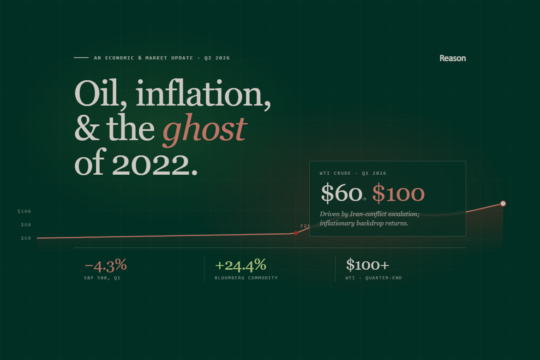
2nd Quarter 2026 – Economic and Market Update
Q1 2026 in review: oil shock, S&P 500 down 4.3%, commodities up 24.4%, the cease-fire that became a blockade — and the planning moves that matter most coming out of a quarter like this one.
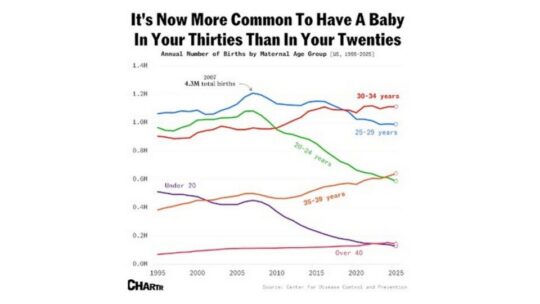
It’s Now More Common To Have A Baby In Your Thirties Than In Your Twenties
DisclosureThis material is for general information only and is not intended to provide specific advice or recommendations for any individual.…

When Does Refinancing Actually Make Sense? A 2026 Reality Check
If you locked in a mortgage at 7% or higher in 2023 or 2024, you’ve probably been watching rates with…