
An Economic and Market Update: Q4 2026
AN ECONOMIC AND MARKET UPDATE
Q4 2026 / July 1 – September 30, 2026
EXECUTIVE SUMMARY
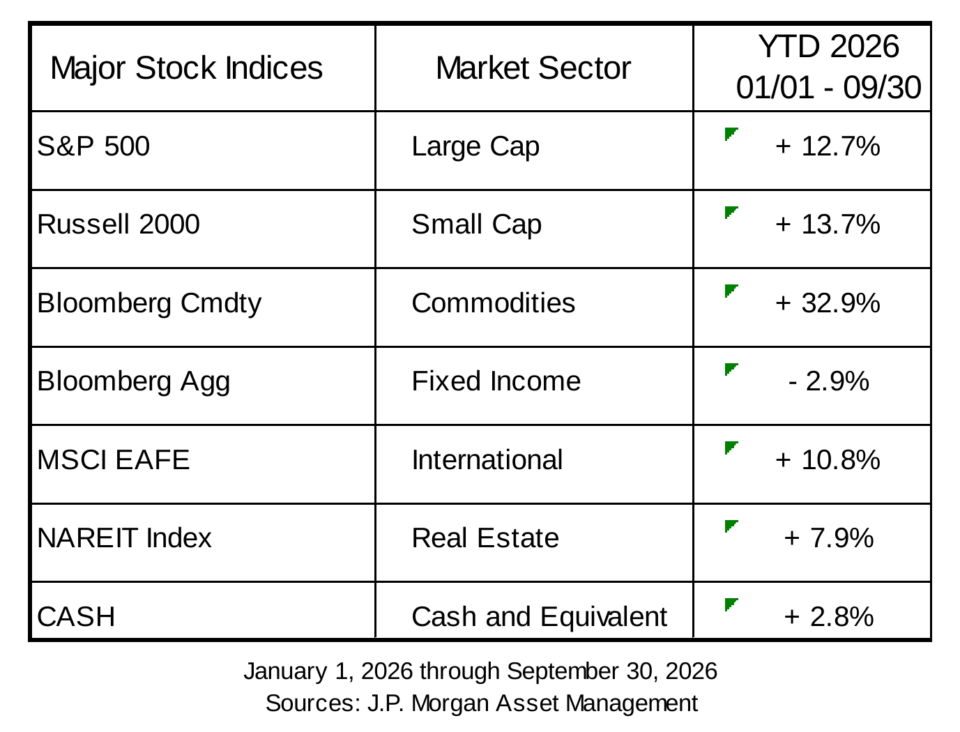
Last quarter, we wrote that rate cuts appeared to be off the table for 2026 and that the Federal Reserve would act if they felt they needed to. In September, they did. The Fed raised their target range by a quarter point to 3.75%–4.00%, the first increase since July 2023. Dr. David Kelly, Chief Global Strategist at J.P. Morgan Asset Management, has called 2026 “a year of distinct seasons for financial markets”: the Iran shock in the first quarter, the technology earnings boom in the second and, in the third, a jump in long-term interest rates. The fourth season, fallout from the midterm elections and an active Fed, is here.
On the surface, the third quarter looked calm. The S&P 500 returned 2.3% for the quarter and 12.7% for the year through September 30, and it set a new record close in early October. Underneath, it was anything but. Energy stocks gained 17.2% while utilities lost 12.4%. Small company stocks fell 7.3%. And the bond market had a difficult quarter, with the Bloomberg U.S. Aggregate Bond Index down 3.5% as the 10-year Treasury yield climbed from 4.44% to 5.29%, its highest quarter-end level since 2007. Commodities were the quarter’s standout, up 16.2%.
Oil was once again the thread running through everything. After falling to roughly $70 a barrel by the end of June, West Texas Intermediate crude climbed above $100 in mid-September as tanker attacks in the Strait of Hormuz and a drone strike on a Saudi pipeline tightened supply, before settling back in the $90’s at quarter-end. Drivers felt it directly. The national average for regular gasoline set a September record of $4.33 a gallon, and diesel, which moves nearly everything we buy, reached roughly $6.45, compared with about $3.75 before the conflict began. Headline inflation followed, rising to 3.7% in September from 3.4% over the summer.
The economy itself remains resilient, if uneven. Second-quarter GDP was revised up to 2.2%, and the U.S. Bureau of Economic Analysis released third-quarter growth figures of 3.4% in recent days. Corporate profits are on pace for their strongest year since the pandemic. At the same time, hiring has slowed (29,000 jobs were added in September) though it remains stronger than expected, and consumer confidence fell to its lowest reading since 2014. An economy that is spending and earning, alongside households that feel squeezed, and interest rates at their highest in nearly two decades: that is the backdrop heading into year-end.
THE FED CHANGES DIRECTION
Throughout the beginning of Chairman Warsh’s tenure, the Fed held steady. At its July meeting, the Federal Open Market Committee left rates at 3.50%–3.75%, with three members dissenting in favor of a hike. Fed Chair Kevin Warsh followed with a firm message at the Jackson Hole symposium in late August, saying the summer’s inflation readings “do not tell me that underlying trends have meaningfully improved.” A stronger-than-expected August jobs report, a hotter-than-expected core inflation reading and oil above $100 did the rest. By the September meeting, futures markets were pricing a hike as a near certainty.
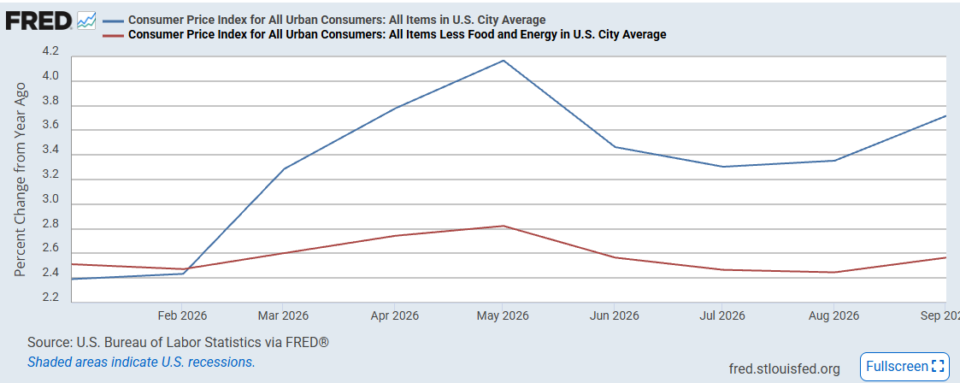
Source: Federal Reserve Bank of St. Louis, U.S. Data are as of September 2026
The decision was unanimous and rates were hiked a quarter point. The Fed’s statement noted that inflation “remains elevated” and that the Committee is seeking “a timelier return” to its 2% goal. You can see the 2026 inflation figures in the chart above. The red line represents the CPI less food and energy. Inflation, at the present moment, revolves around kitchen table issues, the price of food and the price of gas. The Federal Reserve’s updated projections show a median federal funds rate of 4.1% at year-end, which implies one more quarter-point increase, with 16 of 18 officials expecting at least one more hike in 2026. The Fed now projects core PCE inflation of 3.4% this year, easing to 2.5% in 2027.
What stood out to us is how many experienced observers were not convinced the hike was needed. Dr. Kelly put it plainly: “On balance, I don’t believe that the Federal Reserve should have raised interest rates last week.” Goldman Sachs’ economists shifted their forecast to a September hike only in mid-September, describing the change as driven primarily by market pricing rather than a significant change in their economic outlook. Merit Financial Group’s Chief Investment Officer, Brian Andrew, speaking to advisors on the day of the decision, saw it as an acknowledgment that the Fed is behind on inflation: price increases have run near 3% against a 2% target, and the Fed had attributed much of that gap to temporary factors like tariffs and oil.
Where does that leave us? Minutes from the September meeting showed that another increase “would likely be appropriate by year end.” Most forecasters, including J.P. Morgan and Goldman Sachs, expect that hike in December rather than October; as Dr. Kelly noted, raising rates six days before the midterm elections “would be foolhardy to say the least”, the Fed agreed and held rates steady. After that, the consensus expects a pause. As Dr. Kelly puts it, “While the return to 2% inflation has been delayed, we don’t think it has been derailed,” and he is clear that the path still hinges on the Middle East. If shipping through the Strait of Hormuz normalizes, energy prices should ease and inflation should follow, gradually.
FIXED INCOME: THE NEW, NEW NORMAL
If the third quarter had one defining move, it was in long-term interest rates. The 10-year Treasury yield began the year at 4.18%, reached 5.29% at the end of September, and briefly touched 5.37% in early October, its highest level since 2002. The 30-year Treasury ended the quarter at 5.64%. This was not only an American story. Government bond yields also rose in Europe, the United Kingdom and Japan, where the 10-year yield reached 3% for the first time since 1996.
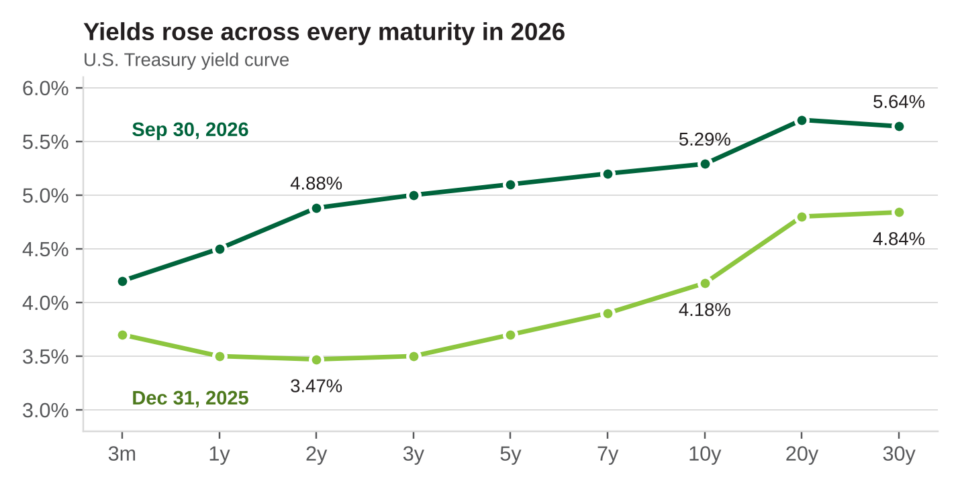
Source: U.S. Treasury; J.P. Morgan Asset Management, Guide to the Markets – U.S. Data are as of September 30, 2026.
Several forces pushed in the same direction: inflation that has stayed above target for more than five years, a Fed now raising rates, and heavy government borrowing. Total federal debt passed $40 trillion in August, and Dr. Kelly’s summary of the fiscal outlook is hard to improve upon: “Absent some dramatic political change, investors should expect that the federal government will go broke slowly.” Add record borrowing by technology companies to fund artificial intelligence, and investors are simply demanding more to lend money for long periods of time. For existing bondholders, that meant falling prices; the 10-year Treasury lost roughly 5% in the quarter.
There is a silver lining, and it is an important one. As Merit’s Chief Investment Officer wrote in early October, “Higher interest rates are both a cost and an opportunity.” With inflation near 2.45% less volatile food and energy, a 10-year yield near 5.3% leaves investors with a real (after-inflation) yield close to 3%. The broad U.S. bond market now yields 5.56%, and historically, starting yield has been one of the strongest predictors of what bonds earn over the following five years. Dr. Kelly agrees that “we have returned to an environment when bonds can provide solid, positive real returns,” with one caveat: bonds are less dependable as a shock absorber when stocks and bonds move together, as they have recently. Our approach is to own bonds for income, spread maturities rather than bet on a single rate forecast and, in Merit’s words, keep duration “intentional, not abandoned.”
THE STOCK MARKET: EARNINGS DID THE HEAVY LIFTING
A 2.3% gain may sound modest, but it came in a quarter when interest rates rose sharply, and rising rates usually weigh on stock prices. The reason stocks held up is earnings. Analysts expect S&P 500 earnings to grow more than 30% in 2026, which Dr. Kelly notes would make this the strongest year for profits since the pandemic. Because earnings grew faster than prices, the market actually became less expensive during the quarter. The forward price-to-earnings ratio fell from 20.4 at the end of June to 19.0 at the end of September.
Leadership shifted again. Last quarter, we wrote about the rest of the market outpacing the largest technology companies. In the third quarter, the Magnificent 7 caught up, and both groups ended September up about 12% for the year. Sector results were far apart. Energy led on higher oil prices, and technology and health care followed. The most interest-rate-sensitive areas of the market (utilities, real estate, small companies and industrials) bore the brunt of the jump in yields.
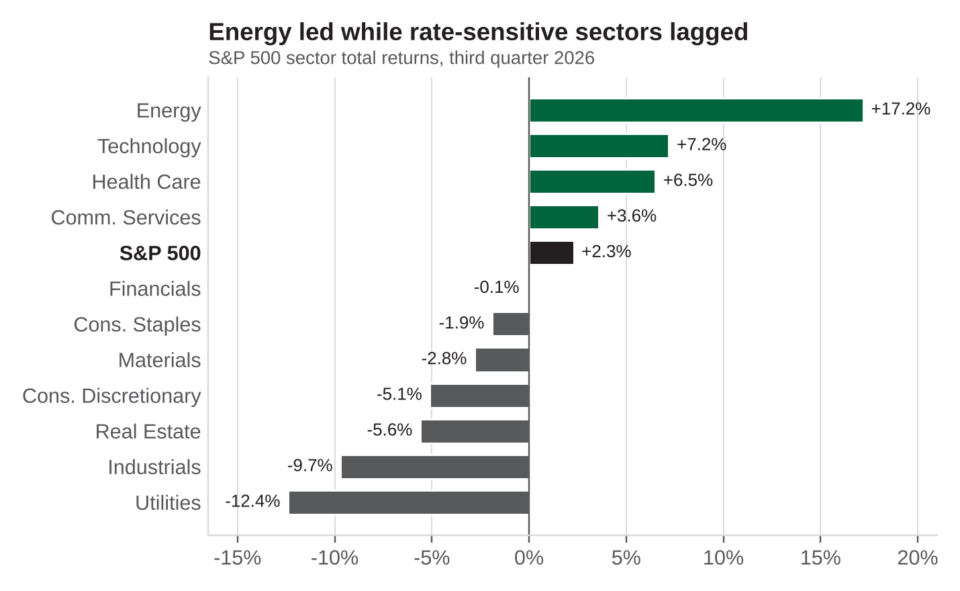
Source: J.P. Morgan Asset Management, Guide to the Markets – U.S.; Standard & Poor’s; FactSet. S&P 500 sector total returns for the third quarter of 2026. Data are as of September 30, 2026.
Artificial intelligence continues to drive much of the story. The five largest cloud providers are expected to spend roughly $799 billion on capital investment this year, nearly double 2025, and more than $1 trillion in 2027. That spending is showing up in the earnings of chipmakers, power providers and industrial companies, not only the technology giants. But the market is becoming more discerning. Goldman Sachs now describes AI as “much more of a stock picker’s market,” and Merit’s Chief Investment Officer cautioned advisors that “things don’t grow to the sky,” pointing to growing local pushback on data centers and a wave of new AI-related investment products that may benefit their sponsors more than investors.
It is helpful to put the pushback against data centers in a local context. One of the most important companies to the metro area of Boise, Idaho is Micron. Micron is also one of the most important companies to the United States chip sector. One of the largest construction projects in the United States right now is the buildout of the Micron campus to increase productive capacity of chips.
Coinciding with this project is a proposal to build a data center near Boise located on public land, specifically Bureau of Land Management acreage. Boise Mayor Lauren McLean has come out adamantly against the project stating that “no data center of this size should be considered anywhere until there is a statewide framework in place that protects Boiseans, Idahoans, and our precision natural resources from the devastating consequences these mega data centers can bring.”
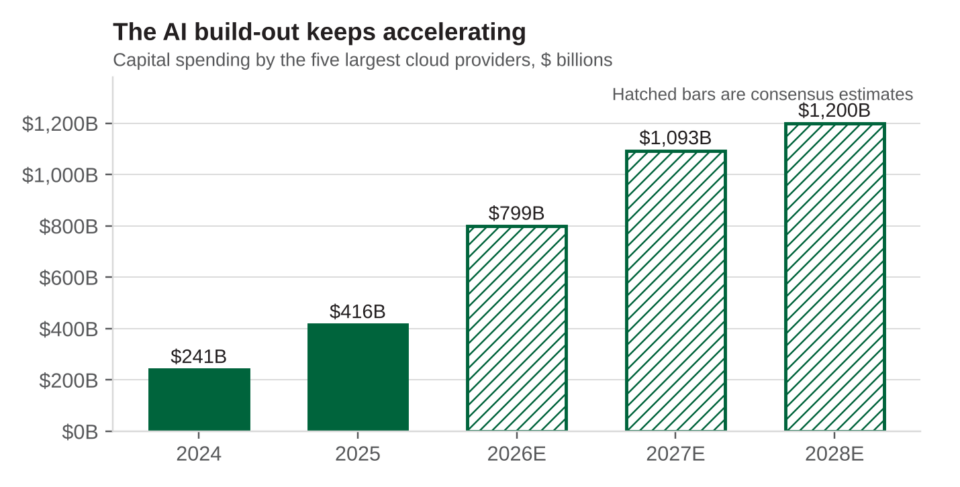
Source: J.P. Morgan Asset Management; company filings; FactSet consensus estimates. Combined capital expenditures of Alphabet, Amazon, Meta, Microsoft and Oracle. 2026–2028 are estimates. Data are as of September 30, 2026.
The question is, will Micron have anywhere to send their product? As you can see above, AI capital expenditures are forecast to increase significantly over the next several years. However, we have run into a significant problem. The companies making the materials that go into the data centers driving the AI revolution won’t have anywhere to send their semi-conductors and chips, if data centers run into significant development roadblocks put up by local municipalities. In our recent elections, 40 of 41 anti-data center ballot measures passed.
The ten largest companies, one of which is Micron, now make up about 41% of the S&P 500. As Dr. Kelly observed, “with rates moving higher, elevated valuations leave less room for error if earnings growth begins to slow.” Goldman Sachs’ base case is for earnings growth to “decelerate, not collapse” in the years ahead. We think that is a reasonable expectation, however the dislocation between cause and effect is fascinating, and opens us up to potential unexpected results. If the mayor of Boise is actively working against the buildout of the sector that is the most important single industry in her city, it makes you wonder to what extent we are all ready to shoot ourselves in the foot. It is a good reminder that the index and a diversified portfolio are not the same thing. Every single one of the top ten companies in the S&P 500 has significant exposure to AI, and therefore, exposure to the winds changing direction on building out AI.
THE FOURTH SEASON: WHAT WE ARE WATCHING
The Fed met on October 28th and kept rates stable, the first estimate of third-quarter GDP arrived and came in at 3.4%, and the largest technology companies reported strong Q3 earnings both on the top and bottom lines. The midterm elections came and went and the Blue Wave forecast these last several months landed with force. The Fed meets again December 8–9, and current government funding runs only through December 11. Further out, the U.S.–China trade truce is set to expire on January 10. Each of these could move markets for a day or a week. Goldman Sachs Asset Management describes elections as generating “near-term noise rather than structural regime shifts,” and that is generally how we view them as well.
The bigger swing factor remains energy. Dr. Kelly expects that a U.S.–Iran agreement after the elections could reopen the Strait of Hormuz and bring energy prices down, which would ease inflation and take pressure off the Fed. Until then, shipping disruptions and attacks in the region will keep oil prices volatile, as they did again in early October. We are also watching the wave of very large initial public offerings expected in the coming months, including a reported listing by AI developer Anthropic. History suggests newly public companies trade less on fundamentals early in their lives, and we would encourage patience over excitement.
INVESTMENT STRATEGY
For the second quarter in a row, the strategists we follow most closely arrived at the same place: rebalance. J.P. Morgan estimates that a portfolio set at 60% stocks and 40% bonds at the end of 2019 and left alone would now hold roughly 74% stocks. Dr. Kelly has encouraged investors to consider “rebalancing portfolios that have drifted into being both overly concentrated and overly aggressive,” and both J.P. Morgan and Goldman Sachs continue to see value outside the U.S. International stocks have outpaced the S&P 500 this year and still trade at a meaningful discount.
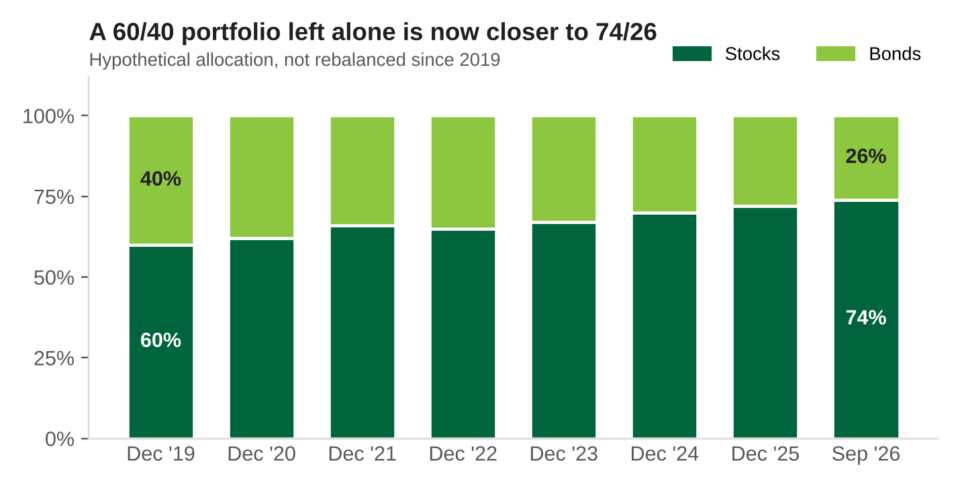
Source: J.P. Morgan Asset Management, Guide to the Markets – U.S. Hypothetical 60/40 portfolio of U.S. stocks, international stocks and U.S. bonds, not rebalanced since December 31, 2019. For illustrative purposes only. Data are as of September 30, 2026.
What about the Fed hike itself? History offers some perspective. Goldman Sachs found that across seven Fed hiking cycles, the S&P 500 averaged a 2% decline in the three months after the first hike but a 9% gain over the following twelve months, and it was positive in every case except 2022. Merit’s investment team sees the combination of higher rates and post election volatility as a potential opportunity to reposition portfolios in the fourth quarter. As always, bringing a portfolio back to its intended mix requires no forecast at all.
THE FINANCIAL PLANNING CORNER
- Harvest losses where the bond market hands them to you. With most bond indexes down for the year, some taxable bond holdings may show losses that can offset gains elsewhere. Swapping into a similar bond at today’s higher yield can improve income at the same time; we will mind the wash-sale rules.
- Think after-tax, not just pre-tax. Many strategies designed to offset large, embedded gains defer taxes rather than eliminate them. Year-end is a good time to review concentrated positions, donate appreciated shares and, for those 70½ or older, consider qualified charitable distributions from IRAs.
- Put idle cash to work deliberately. Default bank sweep accounts often pay far less than money market funds or short-term Treasuries, which are now yielding near multi-year highs. A quick review can add meaningful income with little added risk.
- Mark your calendar. Required minimum distributions must be taken by December 31, and fourth-quarter federal and California estimated tax payments are due January 15, 2027.
As always, our goal is to help you make rational, informed decisions about your financial life, and we thank you for your continued trust and support.
Steve and Sean
SOURCES
- J.P. Morgan Asset Management, “Guide to the Markets – U.S., 4Q 2026,” September 30, 2026. am.jpmorgan.com
- J.P. Morgan Asset Management, “Guide to the Markets – U.S., 3Q 2026,” June 30, 2026. am.jpmorgan.com
- David Kelly, “Economic and Market Update, 4Q 2026” (speaker notes), J.P. Morgan Asset Management, September 30, 2026. am.jpmorgan.com
- David Kelly, “A Top Down View of the Earnings Surge,” Notes on the Week Ahead, J.P. Morgan Asset Management, 20 July 2026. am.jpmorgan.com
- David Kelly, “The Road to $40 Trillion,” Notes on the Week Ahead, J.P. Morgan Asset Management, 25 August 2026. am.jpmorgan.com
- David Kelly, “The New, New Normal,” Notes on the Week Ahead, J.P. Morgan Asset Management, 8 September 2026. am.jpmorgan.com
- David Kelly, “The PCE-CPI Gap and the Outlook for Further Fed Tightening,” Notes on the Week Ahead, J.P. Morgan Asset Management, 21 September 2026. am.jpmorgan.com
- David Kelly, “A Season of Moderation in the Year of Boom and Doom,” Notes on the Week Ahead, J.P. Morgan Asset Management, 12 October 2026. am.jpmorgan.com
- Board of Governors of the Federal Reserve System, “Federal Reserve Issues FOMC Statement” and “Summary of Economic Projections,” 16 September 2026; “Minutes of the Federal Open Market Committee, September 15–16, 2026,” 7 October 2026. federalreserve.gov
- U.S. Bureau of Labor Statistics, “Consumer Price Index – September 2026,” 14 October 2026; “The Employment Situation – September 2026,” 2 October 2026. bls.gov
- U.S. Bureau of Economic Analysis, “Gross Domestic Product, Second Quarter 2026 (Third Estimate)” and “Personal Income and Outlays, August 2026,” 30 September 2026. bea.gov
- Federal Reserve Bank of Atlanta, “GDPNow,” 8 October 2026. atlantafed.org
- Goldman Sachs Research, “Can the S&P 500 Rally as Treasury Yields Rise?” 15 September 2026; “Can AI Investment Drive S&P 500 Earnings Even Higher?” 23 September 2026. goldmansachs.com/insights
- Goldman Sachs, “AI Is Becoming a Stock Picker’s Market,” The Markets, 2 October 2026. goldmansachs.com/insights/the-markets
- Goldman Sachs Asset Management, “Market Know-How 4Q 2026: Yield Ahead,” 6 October 2026. am.gs.com
- Merit Financial Group, Chief Investment Officer, “Is This the New Old Normal? No!” Market Commentary, 6 October 2026.
- Merit Financial Group, Investment Platform and Market Call, 16 September 2026.
- AAA, “National Average Gas Prices,” September 2026. gasprices.aaa.com
- The Conference Board, “Consumer Confidence Index,” 29 September 2026. conference-board.org
- The Motley Fool, “Voters Just Rejected Data Centers in 40 of 41 Ballot Measures. Here Are 4 Midterm Results Investors Can’t Ignore”, 9 November, 2026. fool.com
Disclosure
This material is for general information only and is not intended to provide specific advice or recommendations for any individual. There is no assurance the views or strategies discussed are suitable for all investors or will yield positive outcomes. Investing involves risks including possible loss of principal. Any company names noted herein are for educational purposes only.
All information is believed to be from reliable sources; however we make no representation as to its completeness or accuracy. All economic and performance data is historical and not indicative of future results. Market indices discussed are unmanaged. Investors cannot invest in unmanaged indices. Additional risks are associated with international investing, such as currency fluctuations, political and economic instability and differences in accounting standards.
Investing in securities in emerging markets involves special risks due to specific factors such as increased volatility, currency fluctuations and differences in auditing and other financial standards. Securities in emerging markets are volatile and can decline significantly in response to adverse issuer, political, regulatory, market, or economic developments.
An index is a statistical measure of change in an economy or a securities market. In the case of financial markets, an index is an imaginary portfolio of securities representing a particular market or a portion of it. Each index has its own calculation methodology and is usually expressed in terms of a change from a base value. Thus, the percentage change is more important than the actual numeric value. An investment cannot be made directly into an index.
Investing in fixed income securities involves credit and interest rate risk. When interest rates rise, bond prices generally fall. Investing in commodities may involve greater volatility and is not suitable for all investors. Investing in a non-diversified fund that concentrates holdings into fewer securities or industries involves greater risk than investing in a more diversified fund. The equity securities of small companies may not be traded as often as equity securities of large companies so they may be difficult or impossible to sell. Neither diversification nor asset allocation assure a profit or protect against a loss in declining markets. Past performance is not an indicator of future results.
Financial Planning offered through Reason Financial, a state Registered Investment Advisor. Investment advice offered through Merit Financial Group, LLC an SEC Registered Investment Advisor. Merit Financial Group and Reason Financial are separate entities. Tax related services offered through Reason Tax Group. Reason Tax Group is a separate legal entity and not affiliated with Merit Financial Group, LLC. Sean P. Storck CA Insurance Lic#OF25995 and Steven W. Pollock CA Insurance Lic#OE98073
Copyright © 2026 Reason Financial all rights reserved.
Continue Reading
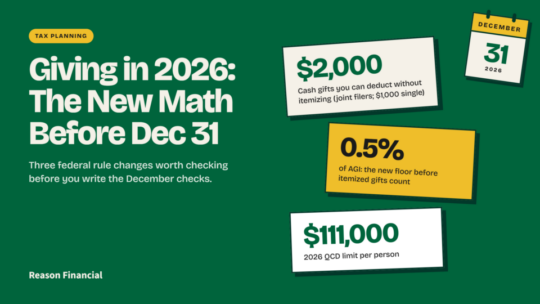
Giving in 2026: What the New Charitable Rules Change Before December 31
Charitable rules change in 2026 for itemizers, non-itemizers and QCDs. What changed, and what families should review with Reason Tax before December 31.

The Longest Commute in San Diego: Gray Whales, Point Loma, and a 10,000 Mile Round Trip
Gray whales pass Point Loma each winter on a roughly 10,000-mile round trip. When to look, how to spot them, and why San Diego gets the best front-row seat.
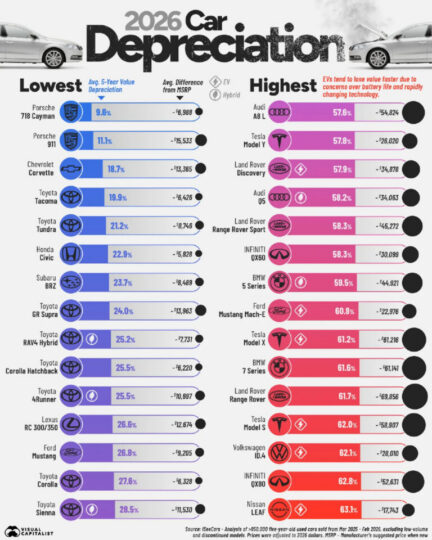
Which Cars Hold Their Value (and Which Don’t)
A 2026 ranking of 950,000+ used cars shows the Porsche 718 Cayman loses 9.6% over five years and the Nissan LEAF 63.1%. See which models hold their value best.