
Which Cars Hold Their Value (and Which Don’t)
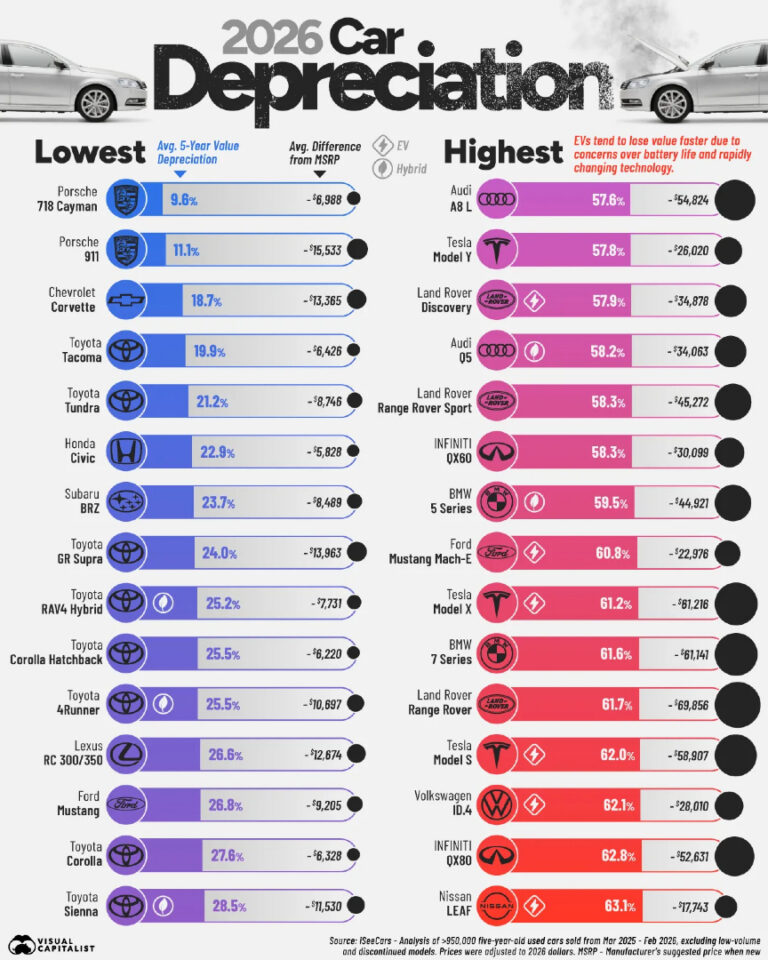
Visual Capitalist’s 2026 ranking, based on iSeeCars data from more than 950,000 five-year-old used cars sold between March 2025 and February 2026, shows a wide spread in how vehicles hold their value. The Porsche 718 Cayman loses just 9.6% over five years, an average of $6,988 off MSRP. The Porsche 911 follows at 11.1%, and the Chevrolet Corvette at 18.7%. At the other end, the Nissan LEAF loses 63.1%, and six EVs land among the 15 fastest-depreciating models. The Land Rover Range Rover posts the largest dollar drop at $69,856.
For families, depreciation is often the biggest cost of owning a car, larger than gas or routine maintenance. Buying a model that holds its value, or shopping a slightly used one that has already taken its steepest hit, can matter as much as the sticker price. Total cost of ownership is the number that counts. That means what you pay up front, what you spend along the way, and what you get back when you sell.
Chart from Visual Capitalist, using iSeeCars data
Disclosure
This material is for general information only and is not intended to provide specific advice or recommendations for any individual. There is no assurance the views or strategies discussed are suitable for all investors or will yield positive outcomes. Investing involves risks including possible loss of principal. Any company names noted herein are for educational purposes only.
All information is believed to be from reliable sources; however we make no representation as to its completeness or accuracy. All economic and performance data is historical and not indicative of future results. Market indices discussed are unmanaged. Investors cannot invest in unmanaged indices. Additional risks are associated with international investing, such as currency fluctuations, political and economic instability and differences in accounting standards.
Investing in securities in emerging markets involves special risks due to specific factors such as increased volatility, currency fluctuations and differences in auditing and other financial standards. Securities in emerging markets are volatile and can decline significantly in response to adverse issuer, political, regulatory, market, or economic developments.
An index is a statistical measure of change in an economy or a securities market. In the case of financial markets, an index is an imaginary portfolio of securities representing a particular market or a portion of it. Each index has its own calculation methodology and is usually expressed in terms of a change from a base value. Thus, the percentage change is more important than the actual numeric value. An investment cannot be made directly into an index.
Investing in fixed income securities involves credit and interest rate risk. When interest rates rise, bond prices generally fall. Investing in commodities may involve greater volatility and is not suitable for all investors. Investing in a non-diversified fund that concentrates holdings into fewer securities or industries involves greater risk than investing in a more diversified fund. The equity securities of small companies may not be traded as often as equity securities of large companies so they may be difficult or impossible to sell. Neither diversification nor asset allocation assure a profit or protect against a loss in declining markets. Past performance is not an indicator of future results.
Financial Planning offered through Reason Financial, a state Registered Investment Advisor. Investment advice offered through Merit Financial Group, LLC an SEC Registered Investment Advisor. Merit Financial Group and Reason Financial are separate entities. Tax related services offered through Reason Tax Group. Reason Tax Group is a separate legal entity and not affiliated with Merit Financial Group, LLC. Sean P. Storck CA Insurance Lic#OF25995 and Steven W. Pollock CA Insurance Lic#OE98073
Copyright © 2026 Reason Financial all rights reserved.
Continue Reading
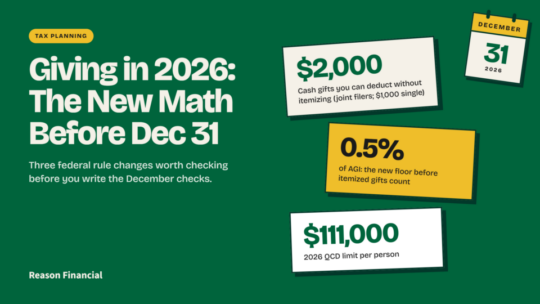
Giving in 2026: What the New Charitable Rules Change Before December 31
If you write a few checks every December, 2026 is the first year the federal charitable rules look different. What changed for non-itemizers, itemizers, and QCDs, and what to review with Reason Tax before year-end.
The Longest Commute in San Diego: Gray Whales, Point Loma, and a 10,000 Mile Round Trip
Stand at Point Loma in January and you might catch a gray whale months into a roughly 10,000-mile round trip. When they pass, how to spot them, and why San Diego gets a front-row seat.
3rd Quarter 2026 – Economic and Market Update
Q2 2026 in review: the S&P 500’s best quarter since 2020, oil’s round trip from $114 back to $70, a 4.2% CPI print that would not quit, and a new Fed chair who took 2026 rate cuts off the table — plus what a 15% quarter means for the allocation you actually own.