By Team Reason | Reason Financial & Tax
If you write a few checks to your favorite causes every December, you already know the calendar pressure. The gift feels settled. The tax rules around it may not be.
The real question is not whether to give. It’s whether the way you give still fits the new math.
This is general information about 2026 federal charitable rules, not advice to give, itemize, or claim any particular deduction. Whether your household may be eligible depends on facts that only a return and a tax professional can sort.
What Changed
Three federal rules matter most for gifts you complete before December 31, 2026.
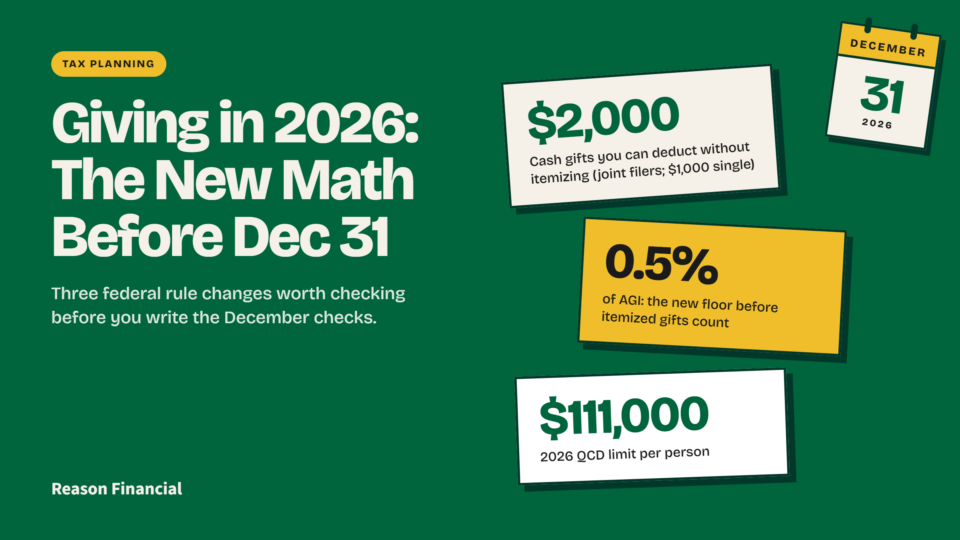
A cash deduction if you do not itemize. Beginning with tax year 2026, if you take the standard deduction you may deduct up to $1,000 of cash contributions to eligible charitable organizations ($2,000 if you file jointly). The IRS Working Families Tax Cuts materials and Internal Revenue Code section 170(p) describe the rule. It is cash only. Clothing, stock, and other noncash gifts do not qualify for this special amount. Donor-advised funds and supporting organizations do not qualify either. The cash has to be contributed during the tax year; prior-year carryovers do not count toward this non-itemizer deduction.
The new 0.5% AGI floor if you itemize. For taxable years beginning after December 31, 2025, section 170(b)(1)(I) allows otherwise deductible charitable contributions as an itemized deduction only to the extent the aggregate exceeds 0.5% of your contribution base (generally adjusted gross income, with the usual statutory adjustments). In plain terms, if you itemize, the first half-percent of AGI in charitable gifts generally sits below the deductible threshold. Gifts above that floor can still affect your return. The statute also sets an order for applying the floor across contribution types.
QCD dollar limits for 2026. Qualified charitable distributions from IRAs remain a separate tool for eligible account holders. IRS Notice 2025-67 sets the 2026 aggregate QCD exclusion at $111,000 per person (up from $108,000) and the one-time split-interest QCD election at $55,000 (up from $54,000). Age eligibility and required minimum distribution rules also apply. Reason Tax can confirm how those rules fit your situation before you act.
One more timing rule that never went away: under section 170(a)(1), a contribution generally counts for the year it is paid. A check you mail or a transfer you complete in January is a 2027 gift for federal income-tax purposes, even if you decided on it in December.
The Math: Two Households
The 2026 standard deduction is $16,100 for single filers and $32,200 for joint filers (IRS IR-2025-103). Those numbers still decide whether you itemize at all.
Household 1: Pacific Beach couple that takes the standard deduction. You and your spouse give mostly by check in December and do not expect to itemize. For 2026, qualifying cash gifts of up to $2,000 may be deductible on top of the $32,200 joint standard deduction. If you are single in the same situation, the cash cap is $1,000 on top of $16,100. Stock, clothing, a donor-advised fund contribution, or a gift to a supporting organization does not use this special non-itemizer line. The illustration shows the cap and the cash-only limit. It does not promise that your gift will produce a deduction.
Household 2: Itemizing household with $200,000 of AGI. Under the 0.5% floor, the first $1,000 of otherwise allowable charitable contributions would not count toward the itemized charitable deduction. You still need enough total itemized deductions to beat the $32,200 joint standard deduction (or $16,100 if you file single). If your other itemized amounts plus charitable gifts above the floor fall short of that standard deduction, you may be better off taking the standard deduction and, if you qualify, the limited non-itemizer cash amount instead.
Some households respond to floors and caps by “bunching” or concentrating two years of planned gifts into one tax year so one year clears the standard deduction and the floor, while the next year takes the standard deduction. Bunching is a common planning conversation. It is not automatically better. Timing, cash flow, the non-itemizer cash cap, and QCD eligibility can all change the result.
These examples use round, verified figures to show mechanics. They are not a projection for any reader, and they do not promise a deduction.
When to Hold Off
Hold or slow a year-end decision when any of the following are true:
- You do not yet know whether you will itemize or take the standard deduction for 2026.
- The gift would be noncash, to a donor-advised fund, or to a supporting organization, and you were counting on the new non-itemizer cash deduction.
- You are near the 0.5% AGI floor and have not mapped how much would be deductible if you itemize.
- You are considering a QCD and have not confirmed current IRS age, distribution, and documentation rules with Reason Tax.
- California treatment of the 2026 federal charitable changes is still unclear for your return. California has not confirmed whether it will conform.
- The payment cannot be completed and documented by December 31.
Looking Ahead to 2027: A New Scholarship Tax Credit
One more federal change starts next year, and it is a credit, not a deduction. Internal Revenue Code section 25F creates a Federal Scholarship Tax Credit for cash contributions made on or after January 1, 2027 (taxable years ending after December 31, 2026) to a qualified Scholarship Granting Organization (SGO). A gift you make in December 2026 does not qualify.
How the credit works. The credit is nonrefundable and capped at $1,700. Under the October 2026 proposed regulations, joint filers may be able to claim up to $3,400 if each spouse contributes separately. Unused credit carries forward for up to five years. The same contribution cannot also be claimed as a charitable deduction, and any state tax credit for the identical gift reduces the federal credit.
Where the SGO is listed matters. The credit is available only for gifts to SGOs certified and listed by a state that has elected to participate. As of October 22, 2026, 30 states have elected to participate under section 25F for 2027, according to the IRS Federal Scholarship Tax Credit participating states list. California has not. California residents can still claim the credit by giving to an SGO listed by a participating state, but the scholarships will support students in that other state. States can still elect to participate for later years.
This is a 2027 planning item, not a year-end action. If a scholarship gift fits your goals, it may belong on your January calendar rather than your December one. Confirm the final rules and current state SGO lists with Reason Tax before you give.
What to Do Next
If year-end giving is on your list, two data points help a short review:
- The approximate amount you plan to give before December 31, 2026, and whether it would be cash or noncash.
- Whether you expect to itemize or take the standard deduction for 2026 (even a best estimate helps).
Book a year-end giving review with Reason Tax to see how these 2026 charitable rules sit alongside your broader financial plan.
Disclosure
This material is for general information only and is not intended to provide specific advice or recommendations for any individual. There is no assurance the views or strategies discussed are suitable for all investors or will yield positive outcomes. Investing involves risks including possible loss of principal. Any company names noted herein are for educational purposes only.
All information is believed to be from reliable sources; however we make no representation as to its completeness or accuracy. All economic and performance data is historical and not indicative of future results. Market indices discussed are unmanaged. Investors cannot invest in unmanaged indices. Additional risks are associated with international investing, such as currency fluctuations, political and economic instability and differences in accounting standards.
Investing in securities in emerging markets involves special risks due to specific factors such as increased volatility, currency fluctuations and differences in auditing and other financial standards. Securities in emerging markets are volatile and can decline significantly in response to adverse issuer, political, regulatory, market, or economic developments.
An index is a statistical measure of change in an economy or a securities market. In the case of financial markets, an index is an imaginary portfolio of securities representing a particular market or a portion of it. Each index has its own calculation methodology and is usually expressed in terms of a change from a base value. Thus, the percentage change is more important than the actual numeric value. An investment cannot be made directly into an index.
Investing in fixed income securities involves credit and interest rate risk. When interest rates rise, bond prices generally fall. Investing in commodities may involve greater volatility and is not suitable for all investors. Investing in a non-diversified fund that concentrates holdings into fewer securities or industries involves greater risk than investing in a more diversified fund. The equity securities of small companies may not be traded as often as equity securities of large companies so they may be difficult or impossible to sell. Neither diversification nor asset allocation assure a profit or protect against a loss in declining markets. Past performance is not an indicator of future results.
Financial Planning offered through Reason Financial, a state Registered Investment Advisor. Investment advice offered through Merit Financial Group, LLC an SEC Registered Investment Advisor. Merit Financial Group and Reason Financial are separate entities. Tax related services offered through Reason Tax Group. Reason Tax Group is a separate legal entity and not affiliated with Merit Financial Group, LLC. Sean P. Storck CA Insurance Lic#OF25995 and Steven W. Pollock CA Insurance Lic#OE98073
Copyright © 2026 Reason Financial all rights reserved.