
Who Let the Dogs In: You may have been greeted by a couple of furry faces.
Who Let the Dogs In
You may have been greeted by a couple of furry faces.
By Jessica Folsom, EA

If you walk through the doors of Reason Financial, you will likely be greeted by a couple of furry faces. Those faces are a part of our families at home and a part of our team at the office. We would like to formally introduce you to the canine mascots of Reason Financial: Joe and Gus. Wet noses, floppy ears, and an insatiable desire for attention are the key character traits of our dogs and we wouldn’t have it any other way. Being greeted by Joe or Gus is an immediate conversation starter and a welcome opening to tell us about a little more about your pet, your family, or yourself. Bringing a small piece of our family into the workplace allows us to share a piece of ourselves with our clients. That being said, let’s get to know the pets at Reason a little better.
Meet Joe
 Joe is a 5-year-old Boxer who loves people. His owner, Jessica, brings him to the office occasionally throughout the week to train and keep an eye on him. He will be the first face you see when walking through the door of Reason Financial, and the last face you see upon your exit.
Joe enjoys running, visiting the gym, Costco dog food and salami treats. He adores the rug in the back of the office and you can frequently find him lounging around back there. Joe can be quite playful and energetic, but is also a very good listener and Jessica’s personal shadow. Once he has successfully greeted a client, you will see him saunter back to her office to make sure she is still there. He has a blue ball at home that he plays with constantly and looks forward to the rare moments he gets to spend on the bed. The highlight of Joe’s day is coming to the office and getting to greet everyone and anyone that stops by. Don’t be afraid to say hello and give him a few pets!
Meet Gus
Gus is a lazy dog, unless he is on a walk. Then he is constantly trying to smell the next best thing. His trips down to the office grew out of a need to get him more time on a leash and a walk down to the office was a very practical way to get that done. We are not sure if he has improved on the leash, but he has become a semi-regular fixture on relaxed Friday’s at the office.
 Gus is most often found lying somewhere near Sean where he can serve watch. The doorway to Sean’s office or the wall just outside of his office is Gus’s favorite place to relax. Occasionally it will be right at Sean’s feet. There is not a lot to say about Gus other than to define him as the epitome of “Man’s Best Friend”. He has a couple of tricks up his sleeve such as giving hugs or shaking a hand, but mostly he is ridiculously loyal. Gus will happily greet you in the office and beg for some love. So go ahead, feel free to give him a few kind words and a pet. He is harmless and his soft ears have been known to make even the most hardened IRS officer wilt under their spell.
We value a pet-friendly environment in our office, and we aren’t the only ones who believe this type of environment can be beneficial. Here are just a few reasons why pets at the office can be valuable:
- Pets relieve stress. [1]
- Pets allow employees to stay active. [2]
- Pets allow for deeper social connections between clients and employees. [3]
The dogs of Reason are an important part of our team. They help us provide a warm and welcoming environment for our clients. We hope the next time you stop by, you are greeted by a wet nose, furry face, and a whole lot of undivided attention – from the canines, of course.
End Notes
[1] Randolph T. Barker, Janet S. Knisely, Sandra B. Barker, Rachel K. Cobb, Christine M. Schubert, (2012) “Preliminary investigation of employee’s dog presence on stress and organizational perceptions”, International Journal of Workplace Health Management, Vol. 5 Issue: 1, pp.15-30
[2] https://www.fastcompany.com/3037205/your-definitive-argument-for-a-pet-friendly-office
[3]https://www.forbes.com/sites/kaytiezimmerman/2016/06/28/6-reasons-dog-friendly-workplaces-attract-millennials/#7a92e96281e9
Disclosure
This material is for general information only and is not intended to provide specific advice or recommendations for any individual. There is no assurance the views or strategies discussed are suitable for all investors or will yield positive outcomes. Investing involves risks including possible loss of principal. Any company names noted herein are for educational purposes only.
All information is believed to be from reliable sources; however we make no representation as to its completeness or accuracy. All economic and performance data is historical and not indicative of future results. Market indices discussed are unmanaged. Investors cannot invest in unmanaged indices. Additional risks are associated with international investing, such as currency fluctuations, political and economic instability and differences in accounting standards.
Investing in securities in emerging markets involves special risks due to specific factors such as increased volatility, currency fluctuations and differences in auditing and other financial standards. Securities in emerging markets are volatile and can decline significantly in response to adverse issuer, political, regulatory, market, or economic developments.
An index is a statistical measure of change in an economy or a securities market. In the case of financial markets, an index is an imaginary portfolio of securities representing a particular market or a portion of it. Each index has its own calculation methodology and is usually expressed in terms of a change from a base value. Thus, the percentage change is more important than the actual numeric value. An investment cannot be made directly into an index.
Investing in fixed income securities involves credit and interest rate risk. When interest rates rise, bond prices generally fall. Investing in commodities may involve greater volatility and is not suitable for all investors. Investing in a non-diversified fund that concentrates holdings into fewer securities or industries involves greater risk than investing in a more diversified fund. The equity securities of small companies may not be traded as often as equity securities of large companies so they may be difficult or impossible to sell. Neither diversification nor asset allocation assure a profit or protect against a loss in declining markets. Past performance is not an indicator of future results.
Financial Planning offered through Reason Financial, a state Registered Investment Advisor. Investment advice offered through Merit Financial Group, LLC an SEC Registered Investment Advisor. Merit Financial Group and Reason Financial are separate entities. Tax related services offered through Reason Tax Group. Reason Tax Group is a separate legal entity and not affiliated with Merit Financial Group, LLC. Sean P. Storck CA Insurance Lic#OF25995 and Steven W. Pollock CA Insurance Lic#OE98073
Copyright © 2026 Reason Financial all rights reserved.
Continue Reading
3rd Quarter 2026 – Economic and Market Update
Q2 2026 in review: the S&P 500’s best quarter since 2020, oil’s round trip from $114 back to $70, a 4.2% CPI print that would not quit, and a new Fed chair who took 2026 rate cuts off the table — plus what a 15% quarter means for the allocation you actually own.
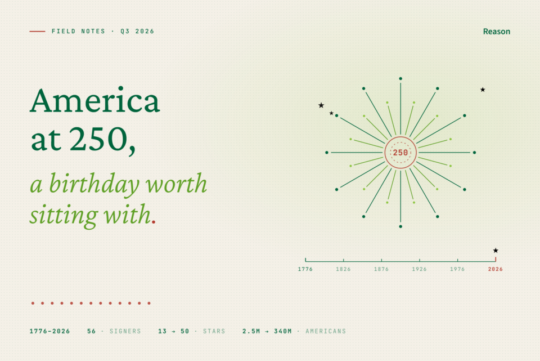
America at 250: A Birthday Worth Sitting With for a Moment
The United States just turned 250 — and the story reads surprisingly well as a series of 50-year check-ins. Founding-era population the size of San Diego County, two presidents with impeccable dramatic timing, a telephone demo in Philadelphia, quarters you’re still finding in your change — and one compounding machine that started counting in 1926.
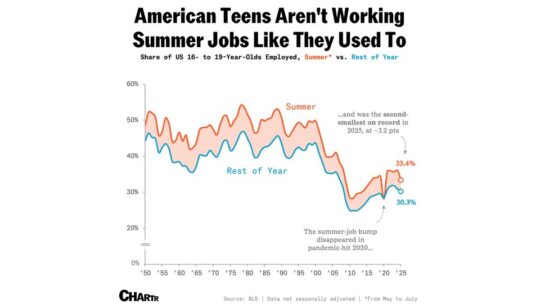
American Teens Aren’t Working Summer Jobs Like They Used To
DisclosureThis material is for general information only and is not intended to provide specific advice or recommendations for any individual.…