
2013: 1st Quarter Update
The fourth quarter of 2012 provided investors a glimpse of how quickly the financial markets can react to any news, be it good or bad.
While several facets of the domestic economy appear to be strengthening, most notably housing, we are committed to our current conservative approach. Our concerns surrounding the global economy run the gamut – potentially overvalued stock market, lack of real economic recovery, and economic uncertainties within the European Economic Union and Middle East – domestic issues, however, are the real concern.
Congress cultivated the drama by missing the year-end deadline for addressing the fiscal cliff issue. In good fashion they managed to fix some issues, resulting in major changes to the tax law. While higher taxes are an inevitable consequence of government spending, the bill has considerable upside for 98 percent of Americans. These include a one year extension of unemployment insurance benefits, making permanent the Bush era tax cuts, and alleviating Wall Street’s fear by capping dividend and capital gains taxes at 20 percent.1
Congress’s last minute negotiation was not all-good news, payroll taxes were increased and the fiscal cliff was left partially unresolved.
PAYROLL TAX CUTS
The repeal of the 2 percent payroll tax cut is the most widely felt tax increase for the working American in 2013. The impact was felt immediately and is estimated to draw $125 billion annually away from households.2 Economic growth will be affected as households are expected to cut back on spending.
January’s retail sales data was the first sign of reduced household spending. The data showed that individual’s bought 0.6 percent fewer goods in January than in December. Economists await the February retail sales data to project the full impact of the payroll tax increase to growth hopes for 2013.3
THE SEQUESTERATION OF DEBT
Congress tactfully delayed its budget showdown by passing legislation to suspend the statutory debt ceiling until May 2013. As a result, on March 1st, $85 billion in federal budget cuts are scheduled to occur. 4
Recent polls conducted by the Pew Research Center found most Americans support the cuts and that the Federal deficit should be a Federal priority. Congress has taken note and while officially out on recess, there is no legislative effort to delay these cuts.5
Among the most impacted are the defense programs with across the board spending cuts for the Army, Navy and Air Force. The reductions will result in the layoff or furlough of at least 450,000 people. 6
Additional cuts will be felt as a projected 9 percent reduction in spending for Federal programs including INS, FDA, TSA, FAA, and other Federal benefit programs such as the long-term unemployed and educational focused programs such as Head Start.7
Reduced Federal spending ultimately impacts all aspects of the supply chain. Stephen Fuller, a Public Policy professor at George Mason University, estimated the loss of 1.4 million private sector jobs as a result of decreases in Federal demand from their vendors and suppliers.8
Opinions vary as to how the financial markets will be impacted by the sequestration of debt. Nonetheless, March 1 is anticipated to be an eventful day as jobs reports, ISM manufacturing index, January Spending, and the consumer sentiment index will all be released.
OUR THOUGHTS
While the markets have fared well for 2013, we maintain our conservative posture to protect against a serious economic punch.
Simply put, our current concern surrounds the pure fact that less money is going to be spent to make the economy grow. Households have less money to spend due to the payroll tax increase (dare we mention that Californians are paying more than $4 per gallon to fill their tank), and the Federal Government is likely to spend much less due to sequestration.
As we noted in our last update, we will maintain a defensive strategy until we believe that the level of risk is significantly reduced in the form of a major market sell-off, the underlying economic data begin to support current stock market valuations, and/or we determine for other reasons that returning to your target allocations is appropriate.
Citations
- http://blogs.wsj.com/totalreturn/2013/01/02/what-the-new-law-means-for-taxpayers/ [1/2/13]
- http://www.huffingtonpost.com/2013/01/13/payroll-tax-boost_n_2467004.html [01/13/13]
- http://www.ft.com/cms/s/0/11608070-7756-11e2-9ebc-00144feabdc0.html#axzz2Lfadac5V [01/14/13
- http://www.wsj.com/article/SB10001424127887324449104578314113835559092.html [2/20/13]
- http://www.cbsnews.com/8301-250_162-57570484/poll-40-say-let-the-looming-budgets-cuts-happen/ [2/21/13]
- http://www.usatoday.com/story/news/nation/2013/02/19/army-state-by-state-sequester-details/1931051/ [02/20/13]
- http://www.cbsnews.com/8301-250_162-57570191/will-sequestration-really-be-that-bad [2/20/13]
- http://boss.blogs.nytimes.com/2013/02/21/many-expect-budget-cuts-to-hit-small-businesses-hard-but-not-the-n-f-i-b/ [2/21/13]
All information is believed to be from reliable sources; however we make no representation as to its completeness or accuracy. All economic and performance data is historical and not indicative of future results. Market indices discussed are unmanaged. Investors cannot invest in unmanaged indices. Additional risks are associated with international investing, such as currency fluctuations, political and economic instability and differences in accounting standards.
Disclosure
This material is for general information only and is not intended to provide specific advice or recommendations for any individual. There is no assurance the views or strategies discussed are suitable for all investors or will yield positive outcomes. Investing involves risks including possible loss of principal. Any company names noted herein are for educational purposes only.
All information is believed to be from reliable sources; however we make no representation as to its completeness or accuracy. All economic and performance data is historical and not indicative of future results. Market indices discussed are unmanaged. Investors cannot invest in unmanaged indices. Additional risks are associated with international investing, such as currency fluctuations, political and economic instability and differences in accounting standards.
Investing in securities in emerging markets involves special risks due to specific factors such as increased volatility, currency fluctuations and differences in auditing and other financial standards. Securities in emerging markets are volatile and can decline significantly in response to adverse issuer, political, regulatory, market, or economic developments.
An index is a statistical measure of change in an economy or a securities market. In the case of financial markets, an index is an imaginary portfolio of securities representing a particular market or a portion of it. Each index has its own calculation methodology and is usually expressed in terms of a change from a base value. Thus, the percentage change is more important than the actual numeric value. An investment cannot be made directly into an index.
Investing in fixed income securities involves credit and interest rate risk. When interest rates rise, bond prices generally fall. Investing in commodities may involve greater volatility and is not suitable for all investors. Investing in a non-diversified fund that concentrates holdings into fewer securities or industries involves greater risk than investing in a more diversified fund. The equity securities of small companies may not be traded as often as equity securities of large companies so they may be difficult or impossible to sell. Neither diversification nor asset allocation assure a profit or protect against a loss in declining markets. Past performance is not an indicator of future results.
Financial Planning offered through Reason Financial, a state Registered Investment Advisor. Investment advice offered through Merit Financial Group, LLC an SEC Registered Investment Advisor. Merit Financial Group and Reason Financial are separate entities. Tax related services offered through Reason Tax Group. Reason Tax Group is a separate legal entity and not affiliated with Merit Financial Group, LLC. Sean P. Storck CA Insurance Lic#OF25995 and Steven W. Pollock CA Insurance Lic#OE98073
Copyright © 2026 Reason Financial all rights reserved.
Continue Reading
3rd Quarter 2026 – Economic and Market Update
Q2 2026 in review: the S&P 500’s best quarter since 2020, oil’s round trip from $114 back to $70, a 4.2% CPI print that would not quit, and a new Fed chair who took 2026 rate cuts off the table — plus what a 15% quarter means for the allocation you actually own.

America at 250: A Birthday Worth Sitting With for a Moment
The United States just turned 250 — and the story reads surprisingly well as a series of 50-year check-ins. Founding-era population the size of San Diego County, two presidents with impeccable dramatic timing, a telephone demo in Philadelphia, quarters you’re still finding in your change — and one compounding machine that started counting in 1926.
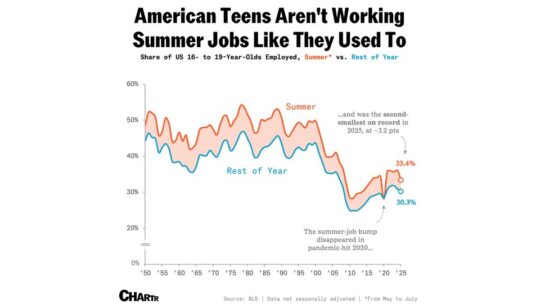
American Teens Aren’t Working Summer Jobs Like They Used To
DisclosureThis material is for general information only and is not intended to provide specific advice or recommendations for any individual.…