
Data Protection and Identity Theft
The NSA has recently garnered headlines around the globe as a result of its covert data gathering program, PRISM. The existence of data gathering surprises very few people but the reality that OUR personal information is being stored is a bit jarring.
Many questions arise when we consider the implications of personal information existing out in the world for others to see and use.
- Who has access?
- What can it be used for?
- Will I know if it is being used?
- Is someone watching out for me and making sure I am not a victim?
- What kind of consequences will I face if my information is stolen and used fraudulently or criminally?
The approach we advocate is one which we believe can be done by anyone, even those of us less tech savvy – Prevent and Monitor.
PREVENT
Prevention is taking care of personal data just like as we would care for our physical property. This is recognition that my personal information is being used regularly, usually for my benefit, and that I need to protect it as much as possible when I am not using it. Bank accounts, credit cards, social media, online banking, financial statements, taxes, and property ownership are all common areas where we regularly access information pertinent to us.
The most effective protection against theft are basic, everyday habits that keep your information safe. These may include password protecting our computers, loging off web sites such as social media, email and online financial institutions, securing physical documents in a safe or filing cabinet and shredding personal documents.
More information about the prevention of Identify Theft can be found at the the FTC Consumer website, How to Keep your Personal Information Secure.
We encourgage you to implement good habits to prevent those seeking to capitalize on data theft. A more active approach to preventing ID Theft involves the monitoring of your financial statements and credit report to detect fraudulent activity.
MONITOR
Every month financial institutions provide account holders with a statement reflecting the recent history to their account. In most cases consumers have access to this information in real time by utilizing the financial institutions online resources. The review and confirmation of your recent transactions is a strategy to effectively identify fraudulent charges to your account.
Online software applications, such as Mint.com®, provide a consolidated approach with bank level encryption and security to the monitoring of your accounts. Sean Storck, Financial and Tax Adviser of Rawdin-Baron Financial, Inc. has personally benefited from the use of Mint.com’s aggregation technology.
Sean Storck – “After the setup process, Mint.com gathers transaction data from each account to where I can see real time, even pending transactions. Twice I have caught fraudulent activity while it was still pending clearance on an unused debit card.”
Another important step to monitoring your financial information is the infrequent check of your credit report. The Fair Credit Reporting Act (FCRA) entitles you to an annual free copy of your credit record with the three reporting companies, Equifax, Experian, and TransUnion.
More information about requesting your annual credit report can be found at the FTC Consumer Website, Free Credit Reports.
In reviewing your credit report you want to ensure that you recognize all of the accounts listed. It may also be a good opportunity to close accounts that are no longer in use, and report any accounts that you do not recognize.
We ask that you proceed with caution when enlisting the services of a credit monitoring or ID theft organization. Many of these services have been fraught with false advertising claims, breaches of their own data, questions regarding effectiveness catching fraud, and concerns about response time.
Ultimately, there is no perfect approach. Pandora’s Box has been opened and our data is available for the taking. However, with good habits to protect data and the active monitoring of you financial history, we believe it is possible to reduce the probabily of being candidates for identity theft.
We welcome your input and ask that you contact us with any questions or to help you establish your own approach to managing your data effectively and securely.
Securities offered through 1st Global Capital Corp., Member FINRA and SIPC. Bruce Rawdin-Baron, Steven W. Pollock, Sean Storck and Nicole Albrecht are Registered Representatives of 1st Global Capital Corp. Investment advisory services, including RBFI portfolios offered through Rawdin-Baron Financial, Inc. IMS platform accounts offered through 1st Global Advisors, Inc. Rawdin-Baron Financial, Inc. and 1st Global Capital Corp. are unaffiliated entities. Rawdin-Baron Financial, Inc. is a Registered Investment Adviser. Insurance services offered through 1st Global Insurance Services. Registration does not imply a certain level of skill or training. We currently have individuals licensed to offer securities in the states of Arizona, California, Illinois, Indiana, Kansas, Massachusetts, Michigan, New York, Oregon and Washington. This is not an offer to sell securities in any other state or jurisdiction. CA Department of Insurance License: Bruce Rawdin-Baron #0736631, Steven W. Pollock #OE98073, Sean Storck #0F25995 and Nicole Albrecht #0F99962
Disclosure
This material is for general information only and is not intended to provide specific advice or recommendations for any individual. There is no assurance the views or strategies discussed are suitable for all investors or will yield positive outcomes. Investing involves risks including possible loss of principal. Any company names noted herein are for educational purposes only.
All information is believed to be from reliable sources; however we make no representation as to its completeness or accuracy. All economic and performance data is historical and not indicative of future results. Market indices discussed are unmanaged. Investors cannot invest in unmanaged indices. Additional risks are associated with international investing, such as currency fluctuations, political and economic instability and differences in accounting standards.
Investing in securities in emerging markets involves special risks due to specific factors such as increased volatility, currency fluctuations and differences in auditing and other financial standards. Securities in emerging markets are volatile and can decline significantly in response to adverse issuer, political, regulatory, market, or economic developments.
An index is a statistical measure of change in an economy or a securities market. In the case of financial markets, an index is an imaginary portfolio of securities representing a particular market or a portion of it. Each index has its own calculation methodology and is usually expressed in terms of a change from a base value. Thus, the percentage change is more important than the actual numeric value. An investment cannot be made directly into an index.
Investing in fixed income securities involves credit and interest rate risk. When interest rates rise, bond prices generally fall. Investing in commodities may involve greater volatility and is not suitable for all investors. Investing in a non-diversified fund that concentrates holdings into fewer securities or industries involves greater risk than investing in a more diversified fund. The equity securities of small companies may not be traded as often as equity securities of large companies so they may be difficult or impossible to sell. Neither diversification nor asset allocation assure a profit or protect against a loss in declining markets. Past performance is not an indicator of future results.
Financial Planning offered through Reason Financial, a state Registered Investment Advisor. Investment advice offered through Merit Financial Group, LLC an SEC Registered Investment Advisor. Merit Financial Group and Reason Financial are separate entities. Tax related services offered through Reason Tax Group. Reason Tax Group is a separate legal entity and not affiliated with Merit Financial Group, LLC. Sean P. Storck CA Insurance Lic#OF25995 and Steven W. Pollock CA Insurance Lic#OE98073
Copyright © 2026 Reason Financial all rights reserved.
Continue Reading
3rd Quarter 2026 – Economic and Market Update
Q2 2026 in review: the S&P 500’s best quarter since 2020, oil’s round trip from $114 back to $70, a 4.2% CPI print that would not quit, and a new Fed chair who took 2026 rate cuts off the table — plus what a 15% quarter means for the allocation you actually own.
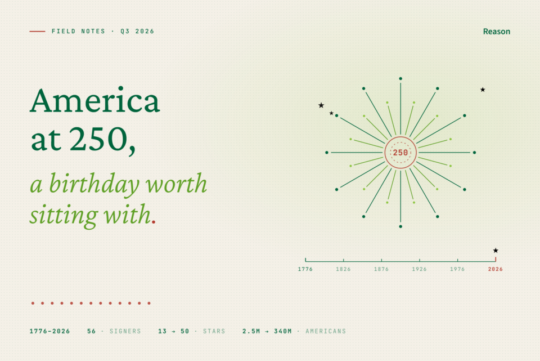
America at 250: A Birthday Worth Sitting With for a Moment
The United States just turned 250 — and the story reads surprisingly well as a series of 50-year check-ins. Founding-era population the size of San Diego County, two presidents with impeccable dramatic timing, a telephone demo in Philadelphia, quarters you’re still finding in your change — and one compounding machine that started counting in 1926.
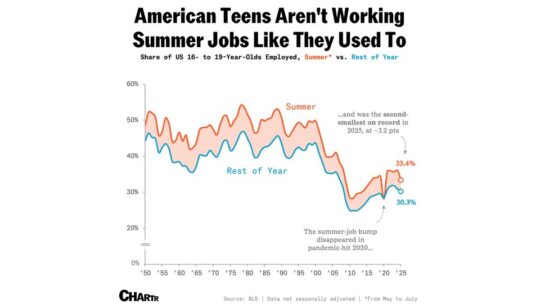
American Teens Aren’t Working Summer Jobs Like They Used To
This Chartr line chart tracks the share of U.S. 16- to 19-year-olds who were employed from 1950 through 2025, split…