
US Labor Market: Do workers meet the needs of Employers
The Federal Reserve Bank of San Francisco (FRBSF) has been examining how the current jobs recovery is affected by a perceived mismatch between jobseekers’ skills and the needs of employers. For Federal Reserve policymakers, skill mismatches affect how quickly the labor market can recover from a recession as well as the rate of unemployment the economy can sustain.
In November of 2011, the FRBSF held a conference, “Creating and Employing a Skilled Work Force: Challenges and Opportunities”, to discuss the relationship between the skills unemployed workers offer and current job openings. Summarized for the public on April 30th, the findings suggest that good jobs are still available in growing sectors for workers of all skill levels.
This concern was reportedly taken up due to the fact that since 2010, job openings have risen faster than unemployment has fallen.
Academics and workforce development professionals were invited to weigh in on the subject. According to the authors of the FRBSF’s Economic Letter summary, skill sets are always dynamic. Any current skill mismatch “has been limited and is likely to dissipate.” More importantly, attending experts asserted that sectors experiencing growth would likely create good jobs for workers whom our educational system can help equip with relevant skills. Hence, what we are experiencing is part of the normal adjustments required by shrinking and growing economic sectors.
The four papers presented addressed a wide range of challenges faced by the job recovery: skill mismatches versus geographical mismatches related to a depressed housing market that has restricted workers’ ability to relocate; the growing scarcity of high-paying jobs that do not require advanced skills and the increased importance of ‘soft’ job skills, such as the ability to communicate affectively; the rise of the modern retailer and the jobs being created in the retail sector that offer high wages to supervisors and managers willing to acquire additional skills; and the role community colleges can play in counseling students about earning prospects while also expanding programs in high-return fields.
Workforce recovery experts participated in a roundtable discussion. Again, the consensus was that no new sources of skill mismatch have emerged but that low-skilled urban workers could benefit from access to specifically designed training programs. They noted the crucial relationship between community colleges and local business communities as well as the importance of placing low-skilled workers in stable jobs in specific industries opposed to simply seeking job openings across the labor market.
The overall conclusion published in the conference summary indicated that the “Great Recession” has not accelerated any labor market changes. Minimal skill mismatches that have developed in recent years are limited and will be corrected in the short term. While community colleges and targeted training programs can help integrate low-skilled workers, concerns of a greater systemic problem may have been overblown.
The Federal Reserve Bank of San Francisco (FRBSF) has been working to better understand how the current pace of the jobs recovery is affected by the mismatch between jobseekers’ skills and the needs of the employer. For Federal Reserve policymakers, skill mismatches will affect how quickly the labor market can recover from a recession, the rate of unemployment that the economy can sustain.1
To read the full report on Workers Skills and the Job Quality please visit Federal Reserve Bank of San Francisco (FRBSF).
1. http://www.frbsf.org/publications/economics/letter/2012/el2012-13.html
Disclosure
This material is for general information only and is not intended to provide specific advice or recommendations for any individual. There is no assurance the views or strategies discussed are suitable for all investors or will yield positive outcomes. Investing involves risks including possible loss of principal. Any company names noted herein are for educational purposes only.
All information is believed to be from reliable sources; however we make no representation as to its completeness or accuracy. All economic and performance data is historical and not indicative of future results. Market indices discussed are unmanaged. Investors cannot invest in unmanaged indices. Additional risks are associated with international investing, such as currency fluctuations, political and economic instability and differences in accounting standards.
Investing in securities in emerging markets involves special risks due to specific factors such as increased volatility, currency fluctuations and differences in auditing and other financial standards. Securities in emerging markets are volatile and can decline significantly in response to adverse issuer, political, regulatory, market, or economic developments.
An index is a statistical measure of change in an economy or a securities market. In the case of financial markets, an index is an imaginary portfolio of securities representing a particular market or a portion of it. Each index has its own calculation methodology and is usually expressed in terms of a change from a base value. Thus, the percentage change is more important than the actual numeric value. An investment cannot be made directly into an index.
Investing in fixed income securities involves credit and interest rate risk. When interest rates rise, bond prices generally fall. Investing in commodities may involve greater volatility and is not suitable for all investors. Investing in a non-diversified fund that concentrates holdings into fewer securities or industries involves greater risk than investing in a more diversified fund. The equity securities of small companies may not be traded as often as equity securities of large companies so they may be difficult or impossible to sell. Neither diversification nor asset allocation assure a profit or protect against a loss in declining markets. Past performance is not an indicator of future results.
Financial Planning offered through Reason Financial, a state Registered Investment Advisor. Investment advice offered through Merit Financial Group, LLC an SEC Registered Investment Advisor. Merit Financial Group and Reason Financial are separate entities. Tax related services offered through Reason Tax Group. Reason Tax Group is a separate legal entity and not affiliated with Merit Financial Group, LLC. Sean P. Storck CA Insurance Lic#OF25995 and Steven W. Pollock CA Insurance Lic#OE98073
Copyright © 2026 Reason Financial all rights reserved.
Continue Reading
3rd Quarter 2026 – Economic and Market Update
Q2 2026 in review: the S&P 500’s best quarter since 2020, oil’s round trip from $114 back to $70, a 4.2% CPI print that would not quit, and a new Fed chair who took 2026 rate cuts off the table — plus what a 15% quarter means for the allocation you actually own.

America at 250: A Birthday Worth Sitting With for a Moment
The United States just turned 250 — and the story reads surprisingly well as a series of 50-year check-ins. Founding-era population the size of San Diego County, two presidents with impeccable dramatic timing, a telephone demo in Philadelphia, quarters you’re still finding in your change — and one compounding machine that started counting in 1926.
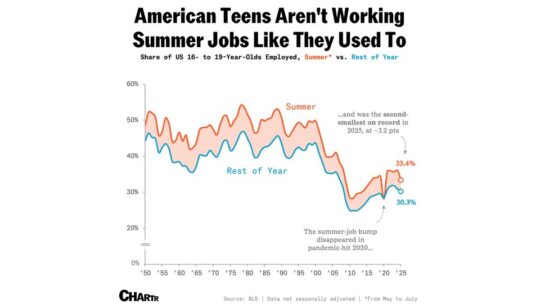
American Teens Aren’t Working Summer Jobs Like They Used To
This Chartr line chart tracks the share of U.S. 16- to 19-year-olds who were employed from 1950 through 2025, split…