
Are You Rushing Into Retirement
More Americans are claiming their Social Security benefits early.
In 2010 something happened for the first time ever, a majority of Americans claimed to be planning for an early retirement. According to a recent Gallop poll, that percentage has only increased. Early retirement is a right many workers have earned. However, it may not be the best option for a stress-free environment.1
If your job is truly a grind, perhaps you’re counting the days until you can stay home. A job that takes a physical toll is clearly harder to maintain when early retirement is offered. Perhaps you have a new venture or some traveling planned for your free time.
However, if your workday is pleasurable, you are making a good wage and you enjoy the people you work with, there are a lot of reasons to stay employed until full retirement age. At the very least, there are some important questions you should ask yourself.
Will you be retiring in debt?
Making payments on your education, home or a business you have operated won’t be easier without an income stream. Significant financial obligations are no way to transition into post-working life. A debt-free retirement is a gift to yourself and your spouse. If you can pay off a large portion of your debt, or even close it out completely, it may be worth a few more years at work.
Some debts, like credit cards, may seem manageable. However, imagine if you could invest the money you will be using to make payments. Investments that allow for disposable income will have more importance in your retirement years. Equities that pay a dividend could be purchased in manageable amounts each month instead of paying a credit card bill. At the very least, being debt free will leave you in better position to make money if an investment opportunity should arise.
Do you have the savings you’ll need?
Retirement can be an exciting chapter in life when there is a chance to explore new endeavors and spend more time with loved ones. However, if you are not earning an income, appropriate savings are crucial.
If you are close to retirement, you may be earning more than you ever have. A few more years’ worth of wages would be a nice supplement to your nest egg. More time saving will also allow your employers’ retirement plan or your IRA to further compound and grow.
The less retirement years to finance, the more you will have to spend. You will also be better prepared for any unforeseen medical costs that arise. If you are 62, waiting just 4 years to retire means less time on a fixed income and not having to scramble for healthcare stop gaps until Medicare kicks in.
Have you maximized your workplace retirement plan?
Tax deferred savings plans can help savers minimize their tax burden. With a traditional, SEP or simple IRA no withdrawal is required until the age of 70 ½. A required minimum distribution or RMD will then be required each year. It may be advantageous to wait until a year when income is minimal in order to lower the tax rate of each year’s withdrawal.
Many workplace retirement plans don’t require withdrawals until you retire. When you continue to work for your employer, you continue to shield your 401(k) or 403 (b) from taxed distributions. Your money can continue to compound and be reinvested. You also won’t risk being pushed into a higher tax bracket for the additional income of the withdrawal.2
Are you leaving money on the table?
Claiming federal retirement benefits early does have a cost. For example, claiming benefits at 62 instead of 67 can cost up to 30 percent in monthly benefits during 2014. On the other hand, delaying your Social Security will earn you more. From 62 to 69, stay insured and you are able to earn delayed retirement credits worth up to 8 percent of your benefits each year they are postponed. Staying with your employer may also be a more affordable way to keep health insurance.3,4
Will you have the peace of mind to retire happy?
Financial planners are encouraging baby-boomers to take a long, hard look at the expenses they will face. However, the most rewarding aspect of working later may be much simpler. A 2012 study from the American Psychological Association Center for Organizational Excellencefound that workers past 55 are most likely to enjoy their work experience. If you are not being forced to retire, are in good health and still get satisfaction from your job, why not add to your security?5
In the end, an early retirement might sound like a great idea, but a little patience may add a great deal to your nest egg.
Securities offered through 1st Global Capital Corp., Member FINRA and SIPC. Bruce Rawdin-Baron, Steven W. Pollock, Sean Storck and Nicole Albrecht are Registered Representatives of 1st Global Capital Corp. Investment advisory services, including RBFI portfolios offered through Rawdin-Baron Financial, Inc. IMS platform accounts offered through 1st Global Advisors, Inc. Rawdin-Baron Financial, Inc. and 1st Global Capital Corp. are unaffiliated entities. Rawdin-Baron Financial, Inc. is a Registered Investment Adviser. Insurance services offered through 1st Global Insurance Services. Registration does not imply a certain level of skill or training. We currently have individuals licensed to offer securities in the states of Arizona, California, Illinois, Indiana, Kansas, Massachusetts, Michigan, New York, Oregon and Washington. This is not an offer to sell securities in any other state or jurisdiction. CA Department of Insurance License: Bruce Rawdin-Baron #0736631, Steven W. Pollock #OE98073, Sean Storck #0F25995 and Nicole Albrecht #0F99962.
END NOTES
- 1. http://money.usnews.com/money/retirement/articles/2013/06/10/the-ideal-retirement-age
- 2. http://www.usaa.com/inet/pages/ret_minimum_distributions
- 3. http://www.forbes.com/sites/nextavenue/2013/05/16/women-retire-earlier-than-men-but-dont-have-to/
- 4. http://www.ssa.gov/oact/quickcalc/early_late.html
- 5. http://business.time.com/2013/03/15/workers-who-delay-retirement-may-be-happiest/
Disclosure
This material is for general information only and is not intended to provide specific advice or recommendations for any individual. There is no assurance the views or strategies discussed are suitable for all investors or will yield positive outcomes. Investing involves risks including possible loss of principal. Any company names noted herein are for educational purposes only.
All information is believed to be from reliable sources; however we make no representation as to its completeness or accuracy. All economic and performance data is historical and not indicative of future results. Market indices discussed are unmanaged. Investors cannot invest in unmanaged indices. Additional risks are associated with international investing, such as currency fluctuations, political and economic instability and differences in accounting standards.
Investing in securities in emerging markets involves special risks due to specific factors such as increased volatility, currency fluctuations and differences in auditing and other financial standards. Securities in emerging markets are volatile and can decline significantly in response to adverse issuer, political, regulatory, market, or economic developments.
An index is a statistical measure of change in an economy or a securities market. In the case of financial markets, an index is an imaginary portfolio of securities representing a particular market or a portion of it. Each index has its own calculation methodology and is usually expressed in terms of a change from a base value. Thus, the percentage change is more important than the actual numeric value. An investment cannot be made directly into an index.
Investing in fixed income securities involves credit and interest rate risk. When interest rates rise, bond prices generally fall. Investing in commodities may involve greater volatility and is not suitable for all investors. Investing in a non-diversified fund that concentrates holdings into fewer securities or industries involves greater risk than investing in a more diversified fund. The equity securities of small companies may not be traded as often as equity securities of large companies so they may be difficult or impossible to sell. Neither diversification nor asset allocation assure a profit or protect against a loss in declining markets. Past performance is not an indicator of future results.
Financial Planning offered through Reason Financial, a state Registered Investment Advisor. Investment advice offered through Merit Financial Group, LLC an SEC Registered Investment Advisor. Merit Financial Group and Reason Financial are separate entities. Tax related services offered through Reason Tax Group. Reason Tax Group is a separate legal entity and not affiliated with Merit Financial Group, LLC. Sean P. Storck CA Insurance Lic#OF25995 and Steven W. Pollock CA Insurance Lic#OE98073
Copyright © 2026 Reason Financial all rights reserved.
Continue Reading
3rd Quarter 2026 – Economic and Market Update
Q2 2026 in review: the S&P 500’s best quarter since 2020, oil’s round trip from $114 back to $70, a 4.2% CPI print that would not quit, and a new Fed chair who took 2026 rate cuts off the table — plus what a 15% quarter means for the allocation you actually own.
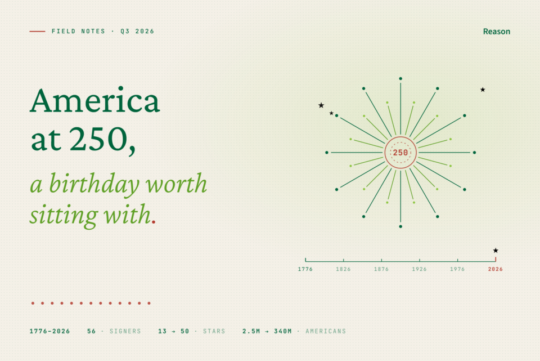
America at 250: A Birthday Worth Sitting With for a Moment
The United States just turned 250 — and the story reads surprisingly well as a series of 50-year check-ins. Founding-era population the size of San Diego County, two presidents with impeccable dramatic timing, a telephone demo in Philadelphia, quarters you’re still finding in your change — and one compounding machine that started counting in 1926.
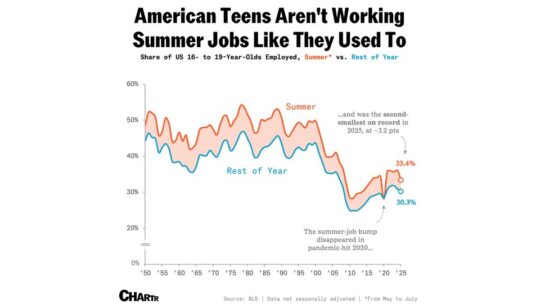
American Teens Aren’t Working Summer Jobs Like They Used To
This Chartr line chart tracks the share of U.S. 16- to 19-year-olds who were employed from 1950 through 2025, split…