
CalSavers Requirements for California Employers
CalSavers Requirements for California Employers
Updated for 2026
Every California employer with at least one employee must now offer a retirement plan. The final phase-in deadline was December 31, 2025. If you have not acted yet, here is what you need to know and how to get compliant.
Who Must Comply
All California employers with one or more employees, including part-time and seasonal staff, must either register for CalSavers or offer their own qualified retirement plan. CalSavers reviews employer payroll filings each year, and a business that newly has employees is notified and given a December 31 registration deadline.
Businesses with only owners and no employees are exempt and can file for an exemption. Religious, tribal and government organizations are also exempt. Employers that already offer a qualified plan are exempt too, but must report the exemption to CalSavers.
Penalties
The state enforces the requirement through notices. If you have not complied within 90 days after receiving a notice, the penalty is $250 per eligible employee. If you are still out of compliance 180 days or more after that notice, an additional $500 per eligible employee applies. An additional $500 per eligible employee can be assessed each year until you comply.
Your Options
You can meet the requirement in one of several ways.
- CalSavers. The state program has no employer fees. Employees are enrolled automatically at 5% of gross pay, and the rate rises by 1% each January up to 8%. Accounts are Roth IRAs by default. Employees have 30 days to opt out before deductions start and can opt out at any time after that. Contributions count toward the employee’s annual IRA limit, which is shared with any other IRA they own.
- ADP Starter-k Complete. For employers that run payroll through ADP, this starter 401(k) integrates with payroll and auto-enrolls employees. ADP lists a $100 monthly base fee, with no participant fee for up to 4 employees and $5 per participant per month at 5 or more. Starter 401(k) plans enroll employees at a default rate the employer sets between 3% and 15%.
- SIMPLE IRA or SEP IRA. Low cost, simple to run, and easy to connect to payroll.
- Full-service or safe harbor 401(k). Higher contribution limits, employer match options, and more tax planning room for owners.
CalSavers is the simplest way to comply. A plan of your own may be a better fit if you want higher limits or an employer contribution.
What to Do Now
- If you have employees and no plan, register for CalSavers or set up a plan as soon as possible.
- If you received a CalSavers notice, respond before the 90-day window ends.
- If you have no employees other than owners and received a CalSavers notice, submit an exemption request.
Contact us if you need help choosing a plan or responding to a CalSavers notice.
Team Reason
Sources: CalSavers Frequently Asked Questions (Employers and Savers); FTB, CalSavers Noncompliance Penalty; ADP, 401(k) Retirement Plans.
Disclosure
This material is for general information only and is not intended to provide specific advice or recommendations for any individual. There is no assurance the views or strategies discussed are suitable for all investors or will yield positive outcomes. Investing involves risks including possible loss of principal. Any company names noted herein are for educational purposes only.
All information is believed to be from reliable sources; however we make no representation as to its completeness or accuracy. All economic and performance data is historical and not indicative of future results. Market indices discussed are unmanaged. Investors cannot invest in unmanaged indices. Additional risks are associated with international investing, such as currency fluctuations, political and economic instability and differences in accounting standards.
Investing in securities in emerging markets involves special risks due to specific factors such as increased volatility, currency fluctuations and differences in auditing and other financial standards. Securities in emerging markets are volatile and can decline significantly in response to adverse issuer, political, regulatory, market, or economic developments.
An index is a statistical measure of change in an economy or a securities market. In the case of financial markets, an index is an imaginary portfolio of securities representing a particular market or a portion of it. Each index has its own calculation methodology and is usually expressed in terms of a change from a base value. Thus, the percentage change is more important than the actual numeric value. An investment cannot be made directly into an index.
Investing in fixed income securities involves credit and interest rate risk. When interest rates rise, bond prices generally fall. Investing in commodities may involve greater volatility and is not suitable for all investors. Investing in a non-diversified fund that concentrates holdings into fewer securities or industries involves greater risk than investing in a more diversified fund. The equity securities of small companies may not be traded as often as equity securities of large companies so they may be difficult or impossible to sell. Neither diversification nor asset allocation assure a profit or protect against a loss in declining markets. Past performance is not an indicator of future results.
Financial Planning offered through Reason Financial, a state Registered Investment Advisor. Investment advice offered through Merit Financial Group, LLC an SEC Registered Investment Advisor. Merit Financial Group and Reason Financial are separate entities. Tax related services offered through Reason Tax Group. Reason Tax Group is a separate legal entity and not affiliated with Merit Financial Group, LLC. Sean P. Storck CA Insurance Lic#OF25995 and Steven W. Pollock CA Insurance Lic#OE98073
Copyright © 2026 Reason Financial all rights reserved.
Continue Reading
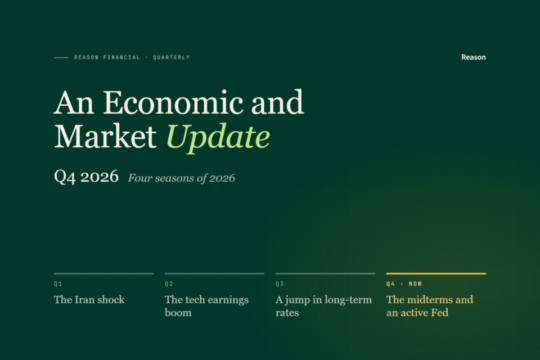
An Economic and Market Update: Q4 2026
AN ECONOMIC AND MARKET UPDATE Q4 2026 / July 1 – September 30, 2026 EXECUTIVE SUMMARY Last quarter, we wrote…

Giving in 2026: What the New Charitable Rules Change Before December 31
Charitable rules change in 2026 for itemizers, non-itemizers and QCDs. What changed, and what families should review with Reason Tax before December 31.

The Longest Commute in San Diego: Gray Whales, Point Loma, and a 10,000 Mile Round Trip
Gray whales pass Point Loma each winter on a roughly 10,000-mile round trip. When to look, how to spot them, and why San Diego gets the best front-row seat.