
The Results Are In: What a Gen Xer Thinks Are the Best Halloween Costumes
For those of us who grew up with rotary phones, Saturday morning cartoons, and cassette tapes, Halloween wasn’t just about sugar rushes and plastic pumpkins — it was a cultural time capsule. Costumes weren’t ordered with a click; they were assembled with ingenuity, parental duct tape, and a touch of DIY grit. So when you ask a Gen Xer to name the best Halloween costumes, you’re really asking them to open a vault of 80s and 90s pop culture reverence, retail scarcity, and good old-fashioned effort.
The Holy Trinity: Pop, Punk, and Practicality
Let’s start with the classics. No Gen X Halloween was complete without at least one Ghostbuster, Teenage Mutant Ninja Turtle, or Princess Leia. These characters weren’t just icons — they were our after-school companions. If you were lucky, your mom braved the sewing machine to make your proton pack out of vacuum hoses and cardboard. If you weren’t, you were rocking a thin plastic mask with a single elastic strap threatening to snap mid-trick-or-treat.
Equally important were the punks and rebels — think Madonna, Mötley Crüe, or Miami Vice. These were the costumes that allowed preteens to flirt with rebellion. A little eyeliner, a lace glove, and suddenly you were borderline inappropriate — which, for a Gen X kid, was basically the point.
Sci-Fi and Screen Time
We also can’t ignore the influence of Hollywood. E.T., Indiana Jones, Freddy Krueger, and Beetlejuice weren’t just Halloween-ready — they were cultural forces. Gen X was the first generation to have VHS on demand (well, if Blockbuster had it in stock), and it shaped our costume choices. Unlike today’s pixel-perfect portrayals, these outfits were interpretive. A striped suit and some white face paint? Boom — Beetlejuice. A leather jacket and squint? Indy. It was budget cosplay before cosplay had a name.
The Gen X Gold Standard: Effort Over Perfection
Perhaps what defines the Gen X Halloween experience most is that we prized effort over authenticity. Today’s kids might have screen-accurate Marvel suits shipped overnight, but we’ll take our crinkly Kmart capes, misapplied face paint, and hand-me-down wigs any day. To us, the best costume was the one you put together with what you had — not the one you paid the most for.
So if you see a Gen Xer walking their kids this Halloween, give a knowing nod if they’re rocking a makeshift MacGyver or a resurrected Run-D.M.C. look. They’re not just dressed up — they’re paying homage to a time when Halloween was gritty, goofy, and gloriously analog.
And finally, what the data tells us is trending now. We have no idea what a kpop demon hunter is, but apparently the kids do.
Disclosure
This material is for general information only and is not intended to provide specific advice or recommendations for any individual. There is no assurance the views or strategies discussed are suitable for all investors or will yield positive outcomes. Investing involves risks including possible loss of principal. Any company names noted herein are for educational purposes only.
All information is believed to be from reliable sources; however we make no representation as to its completeness or accuracy. All economic and performance data is historical and not indicative of future results. Market indices discussed are unmanaged. Investors cannot invest in unmanaged indices. Additional risks are associated with international investing, such as currency fluctuations, political and economic instability and differences in accounting standards.
Investing in securities in emerging markets involves special risks due to specific factors such as increased volatility, currency fluctuations and differences in auditing and other financial standards. Securities in emerging markets are volatile and can decline significantly in response to adverse issuer, political, regulatory, market, or economic developments.
An index is a statistical measure of change in an economy or a securities market. In the case of financial markets, an index is an imaginary portfolio of securities representing a particular market or a portion of it. Each index has its own calculation methodology and is usually expressed in terms of a change from a base value. Thus, the percentage change is more important than the actual numeric value. An investment cannot be made directly into an index.
Investing in fixed income securities involves credit and interest rate risk. When interest rates rise, bond prices generally fall. Investing in commodities may involve greater volatility and is not suitable for all investors. Investing in a non-diversified fund that concentrates holdings into fewer securities or industries involves greater risk than investing in a more diversified fund. The equity securities of small companies may not be traded as often as equity securities of large companies so they may be difficult or impossible to sell. Neither diversification nor asset allocation assure a profit or protect against a loss in declining markets. Past performance is not an indicator of future results.
Financial Planning offered through Reason Financial, a state Registered Investment Advisor. Investment advice offered through Merit Financial Group, LLC an SEC Registered Investment Advisor. Merit Financial Group and Reason Financial are separate entities. Tax related services offered through Reason Tax Group. Reason Tax Group is a separate legal entity and not affiliated with Merit Financial Group, LLC. Sean P. Storck CA Insurance Lic#OF25995 and Steven W. Pollock CA Insurance Lic#OE98073
Copyright © 2026 Reason Financial all rights reserved.
Continue Reading

3rd Quarter 2026 – Economic and Market Update
Q2 2026 in review: the S&P 500’s best quarter since 2020, oil’s round trip from $114 back to $70, a 4.2% CPI print that would not quit, and a new Fed chair who took 2026 rate cuts off the table — plus what a 15% quarter means for the allocation you actually own.
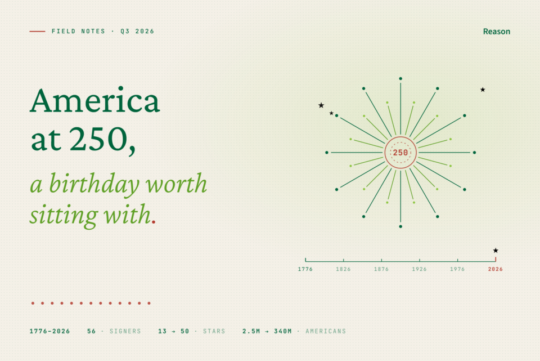
America at 250: A Birthday Worth Sitting With for a Moment
The United States just turned 250 — and the story reads surprisingly well as a series of 50-year check-ins. Founding-era population the size of San Diego County, two presidents with impeccable dramatic timing, a telephone demo in Philadelphia, quarters you’re still finding in your change — and one compounding machine that started counting in 1926.
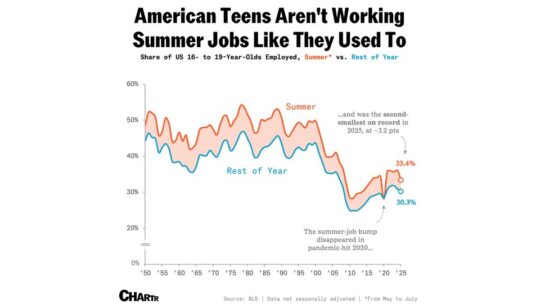
American Teens Aren’t Working Summer Jobs Like They Used To
This Chartr line chart tracks the share of U.S. 16- to 19-year-olds who were employed from 1950 through 2025, split…