
Hoboken Pizza
Hoboken Pizza & Beer: How this local institution’s community ties helped them survive the pandemic.
As Pacific Beach locals, one of Reason Financial’s go-to joints in the area is Hoboken Pizza & Beer. This San Diego institution not only serves up some of the best slices in town, but they have been a staple in the PB community for almost 20 years. It is no secret that the last 18 months have been exceptionally difficult for small business owners everywhere, but with a strong work ethic, a supportive community, and a delicious product, Hoboken Pizza & Beer managed to stay afloat during the height of the pandemic. Owner Tony Kruk sat down with us to discuss more how he kept his small business alive during two extended tax seasons, all while giving back to his community.
Business Resiliency
Founded in 2003, Hoboken Pizza & Beer was conceptualized as an East Coast-meets-West Coast pizza place, bringing the magic of the New Jersey slice to San Diego. For nearly 20 years, Hoboken has been a hub for friends and family to meet for a beer and a meal, so when the COVID-19 crisis struck, Tony Kruk had to adapt to a new normal.
“We depend heavily on word of mouth, so when we didn’t have people inside our restaurant, it was much harder to get exposure,” Kruk said. But he did see one bright spot — increased volume and revenue through food delivery apps. When Tony recognized the prevalence of delivery apps in a world where nobody wanted to leave their couch, he pivoted his strategy towards a delivery app-based approach. In doing so, he was able to increase visibility to the restaurant and sustain his business. “Guidelines and regulations have been constantly up in the air for the past 18 months, so delivery apps were a good constant for us,” Kruk said.
Community Support
Another integral part of Hoboken’s ability to weather the pandemic has been strong, consistent support from long-time regulars and other small businesses in the area. Tony became emotional while discussing the locals who continue to bring light and joy to the restaurant. Some of them have been Hoboken patrons for nearly twenty years, and their continued patronage has truly kept the family element of the restaurant alive.
Something Tony wasn’t expecting? Way that Hoboken and other local small businesses leaned on each other, rather than compete for patronage. “The two blocks surrounding Hoboken Pizza are like one giant family,” Kruk said. “We are always telling customers about each other’s businesses — like, ‘hey, you should go get Mr. Frostie’s ice cream after your pizza!’”
Giving Back Is Part of Hoboken’s Dna
Prior to the pandemic, Hoboken Pizza was very involved with community service; whether it was collecting supplies for and providing free pizza to the God’s Extended Hand homeless shelter, or collecting and matching donations to assist military families in need, Hoboken Pizza was always finding ways to give back. When the pandemic hit, Tony shifted his focus towards thanking the doctors and nurses of the greater San Diego area. Anyone who has ever stepped foot into Hoboken Pizza & Beer remembers the iconic dollar bill walls, collages of signed dollar bills that customers have tacked to the walls to commemorate their dining experiences over the years. Well, that wall is no longer, but not for no good reason — at the start of the pandemic, Tony and crew carefully removed $6,500 from Hoboken’s walls and donated every last penny to supply hospital workers with meals from local restaurants.
“Giving back is super important to us, so in addition to the $6,500 we donated from the walls, we gave away hundreds of pizzas to local hospitals,” Kruk said.
Thank you so much to Tony and everyone else at Hoboken Pizza & Beer for not only providing all of us with delicious food but for serving the Pacific Beach community for the last two decades. We think we could all be more like Tony, so after you’re done seeing us for your taxes, go see Tony for a slice — and maybe even Frostie’s ice cream after that!
Disclosure
This material is for general information only and is not intended to provide specific advice or recommendations for any individual. There is no assurance the views or strategies discussed are suitable for all investors or will yield positive outcomes. Investing involves risks including possible loss of principal. Any company names noted herein are for educational purposes only.
All information is believed to be from reliable sources; however we make no representation as to its completeness or accuracy. All economic and performance data is historical and not indicative of future results. Market indices discussed are unmanaged. Investors cannot invest in unmanaged indices. Additional risks are associated with international investing, such as currency fluctuations, political and economic instability and differences in accounting standards.
Investing in securities in emerging markets involves special risks due to specific factors such as increased volatility, currency fluctuations and differences in auditing and other financial standards. Securities in emerging markets are volatile and can decline significantly in response to adverse issuer, political, regulatory, market, or economic developments.
An index is a statistical measure of change in an economy or a securities market. In the case of financial markets, an index is an imaginary portfolio of securities representing a particular market or a portion of it. Each index has its own calculation methodology and is usually expressed in terms of a change from a base value. Thus, the percentage change is more important than the actual numeric value. An investment cannot be made directly into an index.
Investing in fixed income securities involves credit and interest rate risk. When interest rates rise, bond prices generally fall. Investing in commodities may involve greater volatility and is not suitable for all investors. Investing in a non-diversified fund that concentrates holdings into fewer securities or industries involves greater risk than investing in a more diversified fund. The equity securities of small companies may not be traded as often as equity securities of large companies so they may be difficult or impossible to sell. Neither diversification nor asset allocation assure a profit or protect against a loss in declining markets. Past performance is not an indicator of future results.
Financial Planning offered through Reason Financial, a state Registered Investment Advisor. Investment advice offered through Merit Financial Group, LLC an SEC Registered Investment Advisor. Merit Financial Group and Reason Financial are separate entities. Tax related services offered through Reason Tax Group. Reason Tax Group is a separate legal entity and not affiliated with Merit Financial Group, LLC. Sean P. Storck CA Insurance Lic#OF25995 and Steven W. Pollock CA Insurance Lic#OE98073
Copyright © 2026 Reason Financial all rights reserved.
Continue Reading
3rd Quarter 2026 – Economic and Market Update
Q2 2026 in review: the S&P 500’s best quarter since 2020, oil’s round trip from $114 back to $70, a 4.2% CPI print that would not quit, and a new Fed chair who took 2026 rate cuts off the table — plus what a 15% quarter means for the allocation you actually own.
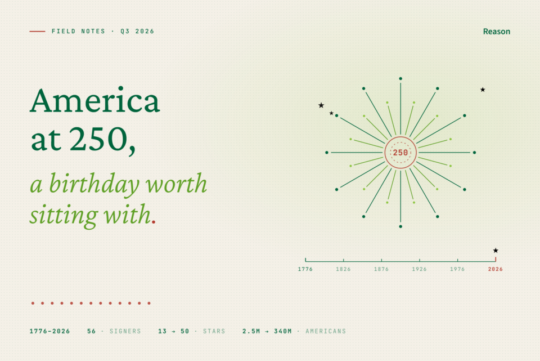
America at 250: A Birthday Worth Sitting With for a Moment
The United States just turned 250 — and the story reads surprisingly well as a series of 50-year check-ins. Founding-era population the size of San Diego County, two presidents with impeccable dramatic timing, a telephone demo in Philadelphia, quarters you’re still finding in your change — and one compounding machine that started counting in 1926.
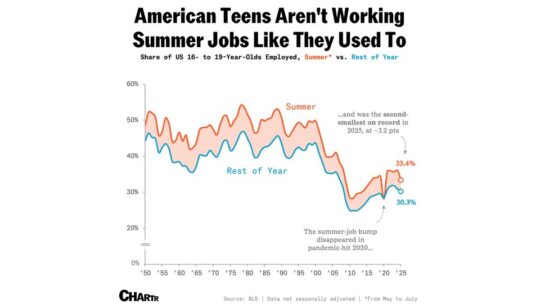
American Teens Aren’t Working Summer Jobs Like They Used To
This Chartr line chart tracks the share of U.S. 16- to 19-year-olds who were employed from 1950 through 2025, split…