
Navigating the Tax Galaxy: Our Recent Journey at Super Seminar 2023
We recently had the pleasure of attending Super Seminar 2023. With over 40 years of history under the guidance of the California Society of Enrolled Agents (CSEA), Super Seminar sets the standard as a beacon for professional development. Attendance at this event affords participants a wealth of knowledge, tools, and resources that foster growth in tax practice and ensures they remain current with the latest tax laws and amendments.
One of the standout sessions was on the Secure 2.0 Act. We delved deep into its provisions, particularly focusing on how these changes will impact our clients. With this newfound knowledge, we are better equipped to offer strategic advice to maximize retirement contributions, plan effectively for retirement, manage required minimum distributions (RMD), and optimize the value of 529 accounts.
Further enriching our experience were the sessions on multi-state income tax and trust tax. These provided us with practical strategies and deep insights, reinforcing the dynamic nature of the tax landscape. Rest assured, we are prepared to tackle these changes head-on.
A shining moment for our team was the presentation by David Woods, EA, USTCP, on “Income Tax Nexus for Business Reporting.” His delivery of this intricate topic was a blend of intellect and humor, with subtle jokes that elicited laughter from the audience. If you know David, you’d understand why his delivery was particularly delightful.
As a team of Certified Public Accountants and Enrolled Agents, we understand that continuous learning lies at the core of our profession. Keeping up with the latest tax laws is crucial, and Super Seminar 2023 provided an excellent opportunity to do so. Fulfilling our annual Continuing Education (CE) requirements is a vital aspect of delivering up-to-date tax knowledge to our clients.
Looking back at Super Seminar 2023, we are filled with a sense of accomplishment and eager anticipation. The knowledge we’ve gathered and the insights we’ve unearthed now strengthen our toolkit as we assist our clients in navigating the intricate tax landscape in 2023.
In the world of tax, knowledge is indeed power, and Super Seminar 2023 served as a powerful boost for our team. We stand ready to apply this newly gained knowledge for the benefit of our clients in 2023 and beyond.
Disclosure
This material is for general information only and is not intended to provide specific advice or recommendations for any individual. There is no assurance the views or strategies discussed are suitable for all investors or will yield positive outcomes. Investing involves risks including possible loss of principal. Any company names noted herein are for educational purposes only.
All information is believed to be from reliable sources; however we make no representation as to its completeness or accuracy. All economic and performance data is historical and not indicative of future results. Market indices discussed are unmanaged. Investors cannot invest in unmanaged indices. Additional risks are associated with international investing, such as currency fluctuations, political and economic instability and differences in accounting standards.
Investing in securities in emerging markets involves special risks due to specific factors such as increased volatility, currency fluctuations and differences in auditing and other financial standards. Securities in emerging markets are volatile and can decline significantly in response to adverse issuer, political, regulatory, market, or economic developments.
An index is a statistical measure of change in an economy or a securities market. In the case of financial markets, an index is an imaginary portfolio of securities representing a particular market or a portion of it. Each index has its own calculation methodology and is usually expressed in terms of a change from a base value. Thus, the percentage change is more important than the actual numeric value. An investment cannot be made directly into an index.
Investing in fixed income securities involves credit and interest rate risk. When interest rates rise, bond prices generally fall. Investing in commodities may involve greater volatility and is not suitable for all investors. Investing in a non-diversified fund that concentrates holdings into fewer securities or industries involves greater risk than investing in a more diversified fund. The equity securities of small companies may not be traded as often as equity securities of large companies so they may be difficult or impossible to sell. Neither diversification nor asset allocation assure a profit or protect against a loss in declining markets. Past performance is not an indicator of future results.
Financial Planning offered through Reason Financial, a state Registered Investment Advisor. Investment advice offered through Merit Financial Group, LLC an SEC Registered Investment Advisor. Merit Financial Group and Reason Financial are separate entities. Tax related services offered through Reason Tax Group. Reason Tax Group is a separate legal entity and not affiliated with Merit Financial Group, LLC. Sean P. Storck CA Insurance Lic#OF25995 and Steven W. Pollock CA Insurance Lic#OE98073
Copyright © 2026 Reason Financial all rights reserved.
Continue Reading
3rd Quarter 2026 – Economic and Market Update
Q2 2026 in review: the S&P 500’s best quarter since 2020, oil’s round trip from $114 back to $70, a 4.2% CPI print that would not quit, and a new Fed chair who took 2026 rate cuts off the table — plus what a 15% quarter means for the allocation you actually own.
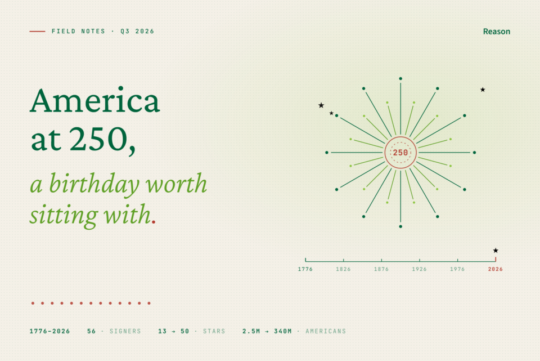
America at 250: A Birthday Worth Sitting With for a Moment
The United States just turned 250 — and the story reads surprisingly well as a series of 50-year check-ins. Founding-era population the size of San Diego County, two presidents with impeccable dramatic timing, a telephone demo in Philadelphia, quarters you’re still finding in your change — and one compounding machine that started counting in 1926.
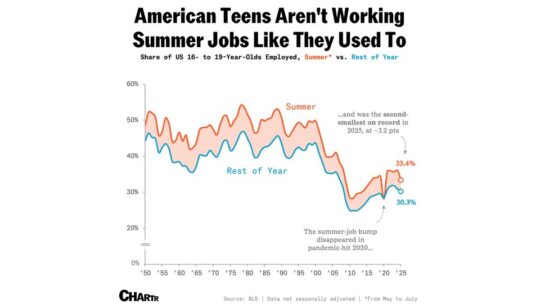
American Teens Aren’t Working Summer Jobs Like They Used To
This Chartr line chart tracks the share of U.S. 16- to 19-year-olds who were employed from 1950 through 2025, split…