
Navy Wife Life
I was living in Long Island, New York on the unforgettable morning of September 11, 2001, when my life changed forever, in an unexpected way. The events of that day inspired many men and women to put the needs of their country first and join the military, including my friend Lenny. Lenny has since been promoted from friend to husband and we now have two daughters ages 10 and 8. Today Lenny is an Air Traffic Control Chief in the United States Navy and I have been by his side through 17.5 years of service from boot camp, through six deployments, seven duty stations, and two cross country moves.
Before fully committing myself to be a military spouse I visited Lenny while he was stationed in Lemoore, CA to do some reconnaissance work of my own. Based on my observations, I developed some expectations of what my future would look like, and shortly after, in 2009, I took a leap of faith. I packed up my Jeep Wrangler, moved to San Diego, and got married. Hindsight is 20/20 and over time I learned that my expectations of military life were a bit miscalculated.
We, military families, were all in the same boat (no pun intended), usually separated from family and friends and often forced to rely on strangers when in need. I was amazed how the common occurrence of desperation between military families quickly cultivated camaraderie and strong friendships. The saying “It takes a village” is extremely relevant amongst military families. I can remember countless times where I have been an emergency contact at school for a child of a new neighbor I just met or having a child live at my house for weeks at a time because their parents were away on assignment and I was their only local option for a family care plan. As quickly as those strong friendships are cultivated, they also come to a screeching halt as military families are usually forced to move every 2-5 years. My children do not have the opportunity to grow roots and have lifelong friends as I did.
Long deployments were something I expected; however, I did not know that 6-month deployments are often extended to 9- or 12-months and always poorly timed. My husband has missed important births, deaths, holidays, and everything in between. I also did not expect the only method of correspondence to a ship in the early 2000s would be first-class mail that took over a month in each direction – luckily ships now have the internet to communicate, although it is still at dial-up speeds.
There are lots of resources available to help make it easier for military spouses to gain employment. They offer tuition assistance, job fairs, resume writing assistance, military spouse preference for Department of Defense jobs, and slightly more affordable childcare options. After college, I was excited to have landed my first real job, but I later learned getting hired was the easy part. Just when I was settled in, fully trained and comfortable, it was time to relocate and start over. Being the only available parent, I had to take time off at work for sick kids, appointments, practices, school breaks, and the occasional global pandemic. We are always on the run and always running late.
While it is easy to look back and see the hurdles we have overcome as a military family, this opportunity to reflect has made me realize how lucky we have been. The Navy has not afforded us life like our friends back on Long Island, as many of them have never left, but I think they are missing out. When a friend leaves the friendship remains and we now have friendships all around the world. While deployments are difficult, you must put up with the rain if you want the rainbow. It is something special for my kids to experience the utmost joy of their father returning home after a long deployment. The constant hustle and bustle of juggling a career, kids, and military life has been a challenge, but it is an accomplishment I am very proud of. Additionally, my husband has had some notable experiences in his military tenure such as shaking hands with a sitting president (Barack Obama), being an extra in the Top Gun 2 filming, being on the Aircraft Carrier carrying Osama Bin Laden’s body, and “meeting” the Stanley Cup. With a short time left in our military journey, we are thankful for where it has taken us and we are excited for the next chapter. Thanks for taking the time to listen and Go Navy!


Disclosure
This material is for general information only and is not intended to provide specific advice or recommendations for any individual. There is no assurance the views or strategies discussed are suitable for all investors or will yield positive outcomes. Investing involves risks including possible loss of principal. Any company names noted herein are for educational purposes only.
All information is believed to be from reliable sources; however we make no representation as to its completeness or accuracy. All economic and performance data is historical and not indicative of future results. Market indices discussed are unmanaged. Investors cannot invest in unmanaged indices. Additional risks are associated with international investing, such as currency fluctuations, political and economic instability and differences in accounting standards.
Investing in securities in emerging markets involves special risks due to specific factors such as increased volatility, currency fluctuations and differences in auditing and other financial standards. Securities in emerging markets are volatile and can decline significantly in response to adverse issuer, political, regulatory, market, or economic developments.
An index is a statistical measure of change in an economy or a securities market. In the case of financial markets, an index is an imaginary portfolio of securities representing a particular market or a portion of it. Each index has its own calculation methodology and is usually expressed in terms of a change from a base value. Thus, the percentage change is more important than the actual numeric value. An investment cannot be made directly into an index.
Investing in fixed income securities involves credit and interest rate risk. When interest rates rise, bond prices generally fall. Investing in commodities may involve greater volatility and is not suitable for all investors. Investing in a non-diversified fund that concentrates holdings into fewer securities or industries involves greater risk than investing in a more diversified fund. The equity securities of small companies may not be traded as often as equity securities of large companies so they may be difficult or impossible to sell. Neither diversification nor asset allocation assure a profit or protect against a loss in declining markets. Past performance is not an indicator of future results.
Financial Planning offered through Reason Financial, a state Registered Investment Advisor. Investment advice offered through Merit Financial Group, LLC an SEC Registered Investment Advisor. Merit Financial Group and Reason Financial are separate entities. Tax related services offered through Reason Tax Group. Reason Tax Group is a separate legal entity and not affiliated with Merit Financial Group, LLC. Sean P. Storck CA Insurance Lic#OF25995 and Steven W. Pollock CA Insurance Lic#OE98073
Copyright © 2026 Reason Financial all rights reserved.
Continue Reading

3rd Quarter 2026 – Economic and Market Update
Q2 2026 in review: the S&P 500’s best quarter since 2020, oil’s round trip from $114 back to $70, a 4.2% CPI print that would not quit, and a new Fed chair who took 2026 rate cuts off the table — plus what a 15% quarter means for the allocation you actually own.

America at 250: A Birthday Worth Sitting With for a Moment
The United States just turned 250 — and the story reads surprisingly well as a series of 50-year check-ins. Founding-era population the size of San Diego County, two presidents with impeccable dramatic timing, a telephone demo in Philadelphia, quarters you’re still finding in your change — and one compounding machine that started counting in 1926.
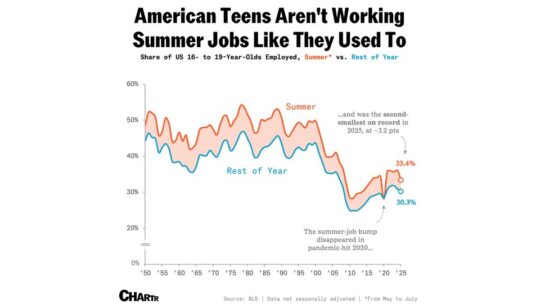
American Teens Aren’t Working Summer Jobs Like They Used To
DisclosureThis material is for general information only and is not intended to provide specific advice or recommendations for any individual.…