By Team Reason | Reason Financial & Tax
If you’ve watched a baseball game this season you’ve noticed something new. A batter freezes on a called third strike, pauses for a beat, then reaches up and taps his helmet. The stadium screen flashes an animated pitch trajectory. The crowd holds its breath. And then: ball three.
Welcome to the Automated Ball-Strike Challenge System, or as everyone in our office is calling it, the robot ump.
How It Works
The idea is simple. A network of high-speed cameras (the same Hawk-Eye system that powers Statcast) tracks every pitch in three dimensions as it crosses the plate, measuring it against a digital strike zone customized to each batter’s height. If the hitter, pitcher, or catcher thinks the home plate umpire blew the call, they tap their helmet or cap (no conferring with the dugout, no manager trotting out to argue) and the system renders its verdict on the big screen for 40,000 people to see.
Each team gets two challenges per game. Win your challenge, you keep it. Lose two, and you’re done for the night. That’s where it gets interesting, because in a game built on strategy, the challenge system has become its own game within the game.
The Numbers So Far
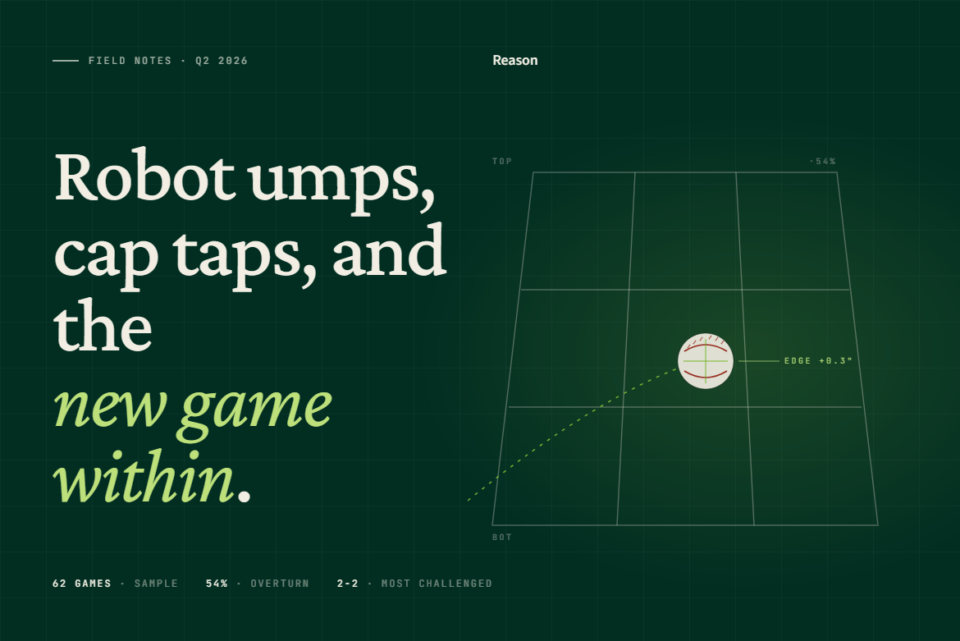
Through the first 62 games of the 2026 season, MLB has logged 227 challenges, an average of 3.7 per game. The league-wide overturn rate sits at 54%, meaning umpires are getting roughly one in every two challenged calls wrong. That number alone is worth sitting with for a moment.
But the success rates vary wildly by who’s doing the challenging. Catchers, who see more pitches than anyone and understand the zone from the closest vantage point in the stadium, are winning their challenges 64% of the time. Hitters come in at 42%. Pitchers have barely used the system at all: five attempts, two wins, 40%. The data is already reshaping how teams decide who gets the green light to tap.
The most telling stat might be the count. Through opening week, the most frequently challenged count was 2-2, which also happens to carry one of the highest expected run value swings in the game at .445. That is not a coincidence. Teams are already optimizing when to spend their challenges based on leverage, not just gut feeling.
The Strategy Game
What’s emerged across the league is a clear split between two philosophies. The Arizona Diamondbacks are running the quality-over-quantity playbook: the lowest combined challenge rate in baseball at 1.5% for catchers and 2.3% for hitters, but a league-best 74% win rate when they do challenge. The Phillies are close behind at 68%. These teams are treating challenges the way a good investor treats capital: deploy it selectively, only when the expected return justifies the risk.
On the other end, the Yankees are swinging at everything: a 9.0% hitter challenge rate and 4.5% catcher rate, the highest in baseball. The question is whether volume or precision wins out over 162 games.
Kansas City’s Salvador Perez might be the early master of the system. He’s gone 4-for-4 on challenges, and the data shows all four were on low fastballs, three of them within half an inch of the zone edge. That kind of pitch-type specificity, knowing exactly which pitches in which locations are most likely to be miscalled, is the next frontier. Expect every front office to be building challenge models by the All-Star break, if they haven’t already.
The Bigger Picture
Here’s the number that puts it all in perspective: the average MLB game in 2026 is running 2 hours and 38 minutes, the shortest league-wide average since 1982. That’s 24 minutes faster than 2022 and nearly 40 minutes shorter than the 2023 peak. The pitch clock started the acceleration. ABS hasn’t slowed it down. If anything, by standardizing the strike zone and reducing the 12-pitch grudge matches between pitchers and batters, it’s contributed to the trend. Plate appearances lasting 10 or more pitches have dropped from 9.3% in 2022 to 5.1% this season.
The standout moment of the early season still belongs to Cincinnati’s Eugenio Suárez, who challenged back-to-back called strikes with the bases loaded and two outs. Both were overturned. The crowd went nuts. Meanwhile, Minnesota’s Matt Wallner challenged a pitch that turned out to be 4.8 inches inside the zone, more than a full baseball’s diameter. Bold move.
Mike Trout went 3-for-4 on challenges over opening weekend, because of course he did.
Why We Love It
Here’s what got our office talking: the cap tap is such a small thing, but it changes the entire dynamic between the player and the umpire. There’s no argument, no dirt-kicking, no ejection. Just a quiet tap, a public review, and an answer. The data doesn’t care about your feelings.
Baseball has always been a game of inches, and now those inches are measured to a tenth of a degree. Some purists hate it. Most of our team thinks it’s the best thing to happen to the game since the pitch clock. Jeff Passan at ESPN agrees, writing that “not only does ABS work, it makes the game better.” Either way, it’s made every called third strike ten times more dramatic, turned every catcher into a strategist, and given us one more thing to argue about at the lunch table.
Play ball.
Team Reason
Sources: MLB.com, ESPN, Sports Illustrated, Yahoo Sports, TSN, SportsGrid, Padres Mission
Disclosure
This material is for general information only and is not intended to provide specific advice or recommendations for any individual. There is no assurance the views or strategies discussed are suitable for all investors or will yield positive outcomes. Investing involves risks including possible loss of principal. Any company names noted herein are for educational purposes only.
All information is believed to be from reliable sources; however we make no representation as to its completeness or accuracy. All economic and performance data is historical and not indicative of future results. Market indices discussed are unmanaged. Investors cannot invest in unmanaged indices. Additional risks are associated with international investing, such as currency fluctuations, political and economic instability and differences in accounting standards.
Investing in securities in emerging markets involves special risks due to specific factors such as increased volatility, currency fluctuations and differences in auditing and other financial standards. Securities in emerging markets are volatile and can decline significantly in response to adverse issuer, political, regulatory, market, or economic developments.
An index is a statistical measure of change in an economy or a securities market. In the case of financial markets, an index is an imaginary portfolio of securities representing a particular market or a portion of it. Each index has its own calculation methodology and is usually expressed in terms of a change from a base value. Thus, the percentage change is more important than the actual numeric value. An investment cannot be made directly into an index.
Investing in fixed income securities involves credit and interest rate risk. When interest rates rise, bond prices generally fall. Investing in commodities may involve greater volatility and is not suitable for all investors. Investing in a non-diversified fund that concentrates holdings into fewer securities or industries involves greater risk than investing in a more diversified fund. The equity securities of small companies may not be traded as often as equity securities of large companies so they may be difficult or impossible to sell. Neither diversification nor asset allocation assure a profit or protect against a loss in declining markets. Past performance is not an indicator of future results.
Financial Planning offered through Reason Financial, a state Registered Investment Advisor. Investment advice offered through Merit Financial Group, LLC an SEC Registered Investment Advisor. Merit Financial Group and Reason Financial are separate entities. Tax related services offered through Reason Tax Group. Reason Tax Group is a separate legal entity and not affiliated with Merit Financial Group, LLC. Sean P. Storck CA Insurance Lic#OF25995 and Steven W. Pollock CA Insurance Lic#OE98073
Copyright © 2026 Reason Financial all rights reserved.