
SPECIAL REPORT on the proposed Tax Reform
SPECIAL REPORT: The Proposed Tax Reform.
By Reason Financial – December 2017


Tax Reform is a monumental task. With competing interests, opportunity costs, and partisan politics, it is nearly impossible. While a cohesive tax bill has not yet reached President Trump’s desk, we are analyzing the House and Senate versions of the tax bill as they are currently written to predict the overall effects of the reform.
We want to help make sense out of the noise and we are doing our best to give you the information necessary to remain informed. Remember, as Schoolhouse Rock so musically and succinctly taught us in 1976, it is a long way from a Bill to a Law. The bill has passed both Houses of Congress and is now in Conference Committee. To provide context for where we are with reform at this point we are providing a link to what we believe are two credible resources on tax reform.
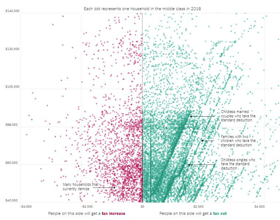
The first piece by the New York Times does a great job analyzing the data on the impact of the tax bill across 25,000 sample households. The most relevant information is based on what will happen over the next ten years. How expiring provisions will impact the tax code ten years down the line is something we can talk about, but is far enough away to be more speculation than actual analysis.
The second piece by the National Review compares the House and Senate plans. There are clear differences between them and it is important to be aware of what they are as the bill heads in to the reconciliation process.
We will continue to do our best to help make sense of the tax reform as it continues through the process. We believe it is important to be informed while we take a wait-and-see approach to the first major tax reform in our country in 31 years.
 The New York Times
“What the Tax Bill Would Look Like for 25,000 Middle-Class Families”, by Quoctrung Bui and Ben Casselman
 National Review
“House and Senate Tax Plans: A Comparison”, by Jibran Khan
Disclosure
This material is for general information only and is not intended to provide specific advice or recommendations for any individual. There is no assurance the views or strategies discussed are suitable for all investors or will yield positive outcomes. Investing involves risks including possible loss of principal. Any company names noted herein are for educational purposes only.
All information is believed to be from reliable sources; however we make no representation as to its completeness or accuracy. All economic and performance data is historical and not indicative of future results. Market indices discussed are unmanaged. Investors cannot invest in unmanaged indices. Additional risks are associated with international investing, such as currency fluctuations, political and economic instability and differences in accounting standards.
Investing in securities in emerging markets involves special risks due to specific factors such as increased volatility, currency fluctuations and differences in auditing and other financial standards. Securities in emerging markets are volatile and can decline significantly in response to adverse issuer, political, regulatory, market, or economic developments.
An index is a statistical measure of change in an economy or a securities market. In the case of financial markets, an index is an imaginary portfolio of securities representing a particular market or a portion of it. Each index has its own calculation methodology and is usually expressed in terms of a change from a base value. Thus, the percentage change is more important than the actual numeric value. An investment cannot be made directly into an index.
Investing in fixed income securities involves credit and interest rate risk. When interest rates rise, bond prices generally fall. Investing in commodities may involve greater volatility and is not suitable for all investors. Investing in a non-diversified fund that concentrates holdings into fewer securities or industries involves greater risk than investing in a more diversified fund. The equity securities of small companies may not be traded as often as equity securities of large companies so they may be difficult or impossible to sell. Neither diversification nor asset allocation assure a profit or protect against a loss in declining markets. Past performance is not an indicator of future results.
Financial Planning offered through Reason Financial, a state Registered Investment Advisor. Investment advice offered through Merit Financial Group, LLC an SEC Registered Investment Advisor. Merit Financial Group and Reason Financial are separate entities. Tax related services offered through Reason Tax Group. Reason Tax Group is a separate legal entity and not affiliated with Merit Financial Group, LLC. Sean P. Storck CA Insurance Lic#OF25995 and Steven W. Pollock CA Insurance Lic#OE98073
Copyright © 2026 Reason Financial all rights reserved.
Continue Reading
3rd Quarter 2026 – Economic and Market Update
Q2 2026 in review: the S&P 500’s best quarter since 2020, oil’s round trip from $114 back to $70, a 4.2% CPI print that would not quit, and a new Fed chair who took 2026 rate cuts off the table — plus what a 15% quarter means for the allocation you actually own.
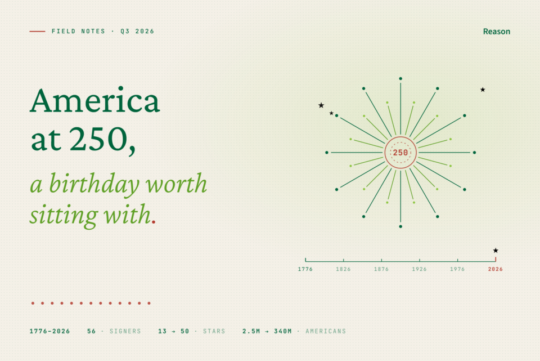
America at 250: A Birthday Worth Sitting With for a Moment
The United States just turned 250 — and the story reads surprisingly well as a series of 50-year check-ins. Founding-era population the size of San Diego County, two presidents with impeccable dramatic timing, a telephone demo in Philadelphia, quarters you’re still finding in your change — and one compounding machine that started counting in 1926.
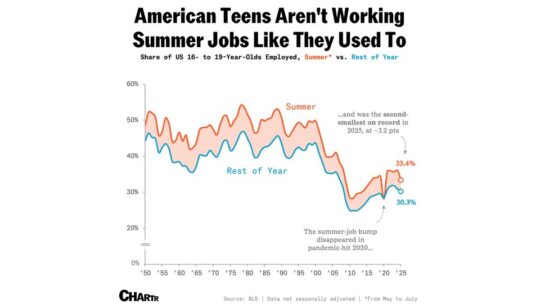
American Teens Aren’t Working Summer Jobs Like They Used To
DisclosureThis material is for general information only and is not intended to provide specific advice or recommendations for any individual.…