
Take Me Out to the Ballgame: Our Reason for the Love of Baseball
As an office teeming with baseball enthusiasts, the appeal of heading out to the ballpark is a universal sentiment here. Whether you’re a fan of the Padres, Dodgers, Cubs, Giants, Yankees, Twins, or Red Sox, like those of us at Team Reason, there’s no denying the joy of experiencing a game live. But what makes baseball so compelling, particularly for those of us in the financial and tax profession? Glad you asked.
Statistics and Analysis
Baseball is renowned for its rich tapestry of statistics, ranging from batting averages to earned run averages. This numerical depth can be particularly engaging for those of us who thrive on working with data and numbers.
Strategic Thinking
The game of baseball involves a considerable amount of strategic decision-making, both during the game and throughout the season. Much like us at Team Reason, we are adept at problem-solving and strategic planning. From deciding when to swing for a home run to managing player line-ups, the strategic elements of baseball can provide valuable insights into effective decision-making processes.
Attention to Detail
Success in baseball often hinges on small details. The precision required to execute a perfect double play or to pitch a no-hitter parallels the meticulous nature of balancing financial statements and ensuring compliance with regulatory standards.
Historical Context
Baseball boasts a long and storied history, filled with significant milestones and records. This historical richness is particularly appealing to financial and tax professionals, who appreciate the importance of historical data and trends in their work. Just as we track financial trends over time, baseball’s historical context provides a fascinating backdrop to the sport’s current events.
Relaxation and Leisure
Beyond the analytical and strategic parallels, baseball games offer a perfect way to unwind from our often high-stress jobs. The leisurely pace of the game allows for socializing and enjoying the outdoors, making it an ideal leisure activity. The ballpark atmosphere provides a much-needed break from the rigors of tax season and reporting deadlines.
Whether it’s through the enjoyment of statistical analysis, strategic thinking, attention to detail, appreciation of history, or simply relaxing at the ballpark, baseball offers something for every financial and tax professional to love. So, let’s grab our caps, enjoy the game, and celebrate the unique synergy between our profession and America’s pastime.
Here’s a glimpse of our team enjoying the ballpark experience
[rl_gallery id=”5393″]
Disclosure
This material is for general information only and is not intended to provide specific advice or recommendations for any individual. There is no assurance the views or strategies discussed are suitable for all investors or will yield positive outcomes. Investing involves risks including possible loss of principal. Any company names noted herein are for educational purposes only.
All information is believed to be from reliable sources; however we make no representation as to its completeness or accuracy. All economic and performance data is historical and not indicative of future results. Market indices discussed are unmanaged. Investors cannot invest in unmanaged indices. Additional risks are associated with international investing, such as currency fluctuations, political and economic instability and differences in accounting standards.
Investing in securities in emerging markets involves special risks due to specific factors such as increased volatility, currency fluctuations and differences in auditing and other financial standards. Securities in emerging markets are volatile and can decline significantly in response to adverse issuer, political, regulatory, market, or economic developments.
An index is a statistical measure of change in an economy or a securities market. In the case of financial markets, an index is an imaginary portfolio of securities representing a particular market or a portion of it. Each index has its own calculation methodology and is usually expressed in terms of a change from a base value. Thus, the percentage change is more important than the actual numeric value. An investment cannot be made directly into an index.
Investing in fixed income securities involves credit and interest rate risk. When interest rates rise, bond prices generally fall. Investing in commodities may involve greater volatility and is not suitable for all investors. Investing in a non-diversified fund that concentrates holdings into fewer securities or industries involves greater risk than investing in a more diversified fund. The equity securities of small companies may not be traded as often as equity securities of large companies so they may be difficult or impossible to sell. Neither diversification nor asset allocation assure a profit or protect against a loss in declining markets. Past performance is not an indicator of future results.
Financial Planning offered through Reason Financial, a state Registered Investment Advisor. Investment advice offered through Merit Financial Group, LLC an SEC Registered Investment Advisor. Merit Financial Group and Reason Financial are separate entities. Tax related services offered through Reason Tax Group. Reason Tax Group is a separate legal entity and not affiliated with Merit Financial Group, LLC. Sean P. Storck CA Insurance Lic#OF25995 and Steven W. Pollock CA Insurance Lic#OE98073
Copyright © 2026 Reason Financial all rights reserved.
Continue Reading

3rd Quarter 2026 – Economic and Market Update
Q2 2026 in review: the S&P 500’s best quarter since 2020, oil’s round trip from $114 back to $70, a 4.2% CPI print that would not quit, and a new Fed chair who took 2026 rate cuts off the table — plus what a 15% quarter means for the allocation you actually own.

America at 250: A Birthday Worth Sitting With for a Moment
The United States just turned 250 — and the story reads surprisingly well as a series of 50-year check-ins. Founding-era population the size of San Diego County, two presidents with impeccable dramatic timing, a telephone demo in Philadelphia, quarters you’re still finding in your change — and one compounding machine that started counting in 1926.
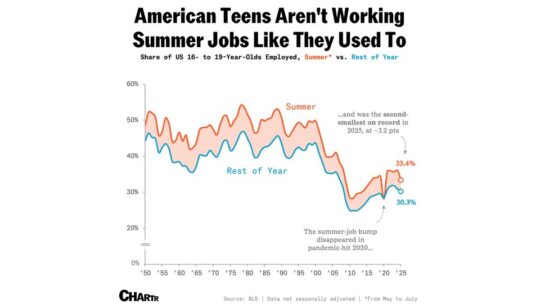
American Teens Aren’t Working Summer Jobs Like They Used To
This Chartr line chart tracks the share of U.S. 16- to 19-year-olds who were employed from 1950 through 2025, split…