
The ABC Test
In 2019, the Governor signed AB 5. Under AB 5, most workers are presumed to be employees for purposes of the Labor Code, the Unemployment Insurance Code, and for most wage orders of the Industrial Welfare Commission unless a hiring entity satisfies a three-factor test, referred to as the ABC test. This means that many workers previously classified as independent contractors are now employees under California law and you must withhold California income and payroll taxes, and meet California’s minimum wage and overtime requirements.
The ABC Test
Under the ABC test, all three of these conditions must be met in order to treat the worker as an independent contractor:
- The worker is free from the control and direction of the hiring entity in connection with the performance of the work, both under the contract for the performance of the work and in fact, commonly known as the Borello “control test” (S.G. Borello & Sons, Inc. v. Dept. of Ind. Rel. (1989) 48 Cal.3rd 342);
- The worker performs work that is outside the usual course of the hiring entity’s business; and
- The worker is customarily engaged in an independently established trade, occupation, or business of the same nature as the work performed.
The ABC test means, for example, that a hospital that hires nurses to work in specialized areas, such as an anesthesia nurse or neonatal nurse, may not treat the nurse as an independent contractor if those nurses are filling in for employee-nurses and don’t work for multiple hospitals. While physicians have their own specific exemption from AB 5, the same treatment would apply to other medical services, as well as consulting services, the entertainment industry, truck drivers and most notably, rideshare and delivery service workers.
Exemptions
While applying the ABC test to workers will result in many more workers being classified as employees, the legislation provides for numerous exemptions to the application of the ABC test. The exemptions are complicated and very specific. However, the exemptions do not mean workers are automatically independent contractors.
If an exemption applies, you are still required to apply the traditional tests to determine if a worker is an employee or an independent contractor. Under these traditional tests, the “B” part of the ABC test will still be considered but is not a make-or-break factor.
Penalties Could Apply
Be aware that California law includes severe financial penalties for willfully treating an employee as an independent contractor.
The penalties, which are in addition to other assessments, penalties, or fines, are:
- $5,000 to $15,000 for each violation (a single misclassified individual); and
- $10,000 to $25,000 for each violation if the Labor Commissioner, or a court, determines there is a “pattern and practice” of these violations.
With the exception of an attorney or other employees of the business, these penalties also apply to your tax professional or any paid person who advises you to incorrectly treat a worker as an independent contractor. This means that you may be required to obtain a legal opinion if there is a question as to the classification of employees.
Important Points
There are three important points to understand:
- Forming or operating as a corporation or an LLC is not a workaround. The corporation or LLC will be ignored if the worker does not meet the ABC test, and the worker who owns the entity will still be an employee of the payor;
- In many cases, the worker may still be an independent contractor for federal purposes if the “A” and “C” test applies. This is an area that we must discuss in detail; and
- The effective date of the law is January 1, 2020, but could be applied retroactively, so time is of the essence.
The law is extremely complex with many unanswered questions. We continue to research and educate ourselves and are available to consult with you regarding this new issue as well as any other tax-related matters.
Disclosure
This material is for general information only and is not intended to provide specific advice or recommendations for any individual. There is no assurance the views or strategies discussed are suitable for all investors or will yield positive outcomes. Investing involves risks including possible loss of principal. Any company names noted herein are for educational purposes only.
All information is believed to be from reliable sources; however we make no representation as to its completeness or accuracy. All economic and performance data is historical and not indicative of future results. Market indices discussed are unmanaged. Investors cannot invest in unmanaged indices. Additional risks are associated with international investing, such as currency fluctuations, political and economic instability and differences in accounting standards.
Investing in securities in emerging markets involves special risks due to specific factors such as increased volatility, currency fluctuations and differences in auditing and other financial standards. Securities in emerging markets are volatile and can decline significantly in response to adverse issuer, political, regulatory, market, or economic developments.
An index is a statistical measure of change in an economy or a securities market. In the case of financial markets, an index is an imaginary portfolio of securities representing a particular market or a portion of it. Each index has its own calculation methodology and is usually expressed in terms of a change from a base value. Thus, the percentage change is more important than the actual numeric value. An investment cannot be made directly into an index.
Investing in fixed income securities involves credit and interest rate risk. When interest rates rise, bond prices generally fall. Investing in commodities may involve greater volatility and is not suitable for all investors. Investing in a non-diversified fund that concentrates holdings into fewer securities or industries involves greater risk than investing in a more diversified fund. The equity securities of small companies may not be traded as often as equity securities of large companies so they may be difficult or impossible to sell. Neither diversification nor asset allocation assure a profit or protect against a loss in declining markets. Past performance is not an indicator of future results.
Financial Planning offered through Reason Financial, a state Registered Investment Advisor. Investment advice offered through Merit Financial Group, LLC an SEC Registered Investment Advisor. Merit Financial Group and Reason Financial are separate entities. Tax related services offered through Reason Tax Group. Reason Tax Group is a separate legal entity and not affiliated with Merit Financial Group, LLC. Sean P. Storck CA Insurance Lic#OF25995 and Steven W. Pollock CA Insurance Lic#OE98073
Copyright © 2026 Reason Financial all rights reserved.
Continue Reading
3rd Quarter 2026 – Economic and Market Update
Q2 2026 in review: the S&P 500’s best quarter since 2020, oil’s round trip from $114 back to $70, a 4.2% CPI print that would not quit, and a new Fed chair who took 2026 rate cuts off the table — plus what a 15% quarter means for the allocation you actually own.

America at 250: A Birthday Worth Sitting With for a Moment
The United States just turned 250 — and the story reads surprisingly well as a series of 50-year check-ins. Founding-era population the size of San Diego County, two presidents with impeccable dramatic timing, a telephone demo in Philadelphia, quarters you’re still finding in your change — and one compounding machine that started counting in 1926.
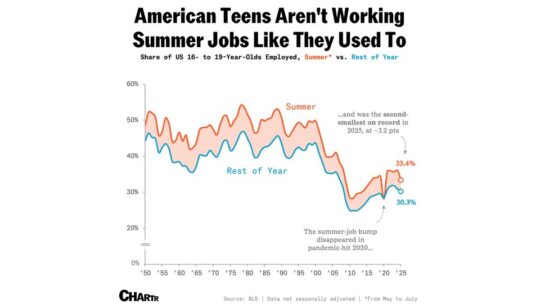
American Teens Aren’t Working Summer Jobs Like They Used To
This Chartr line chart tracks the share of U.S. 16- to 19-year-olds who were employed from 1950 through 2025, split…