
The Credit Freeze
Last summer we shared with you the extent of the Equifax data breach and the impact it had on 143 million American consumers whose personally identifiable information was stolen.
The trend continues and in 2018 alone, several retailers from K-Mart to Sax Fifth Avenue have reported compromised customer data. Even social media giant Facebook was breached, affecting an estimated 87 million records. Sharing data and conducting business online is certainly convenient and has become a fact of life, and it is now up to you to protect your own data.
Our advice continues to be very direct and clear: Freeze Your Credit.
Updated To The Credit Freeze Process
We were pleased to see developments this past year that have made the process of freezing and unfreezing your credit a more manageable process.
First, the major credit bureaus have made significant improvements to their web platforms that allow you to freeze/unfreeze your credit by accessing a portal and requesting a credit lock online. If you took the steps to freeze your credit before these improvements, it would be a good idea to check to ensure you have an online account with each of the three credit bureaus. This will allow for a quick and painless process of unlocking and relocking your credit going forward should you need to. It will also ensure that you have the lock in place as you intended and provide you the opportunity to test out the PIN you created when you created the credit lock.
- For Equifax: www.equifax.com/personal/credit-report-services/
- For Experian: www.experian.com/freeze
- For TransUnion: www.transunion.com/credit-freeze
If you have not yet taken the steps to freeze your credit, the online process is now the easiest way to do so. We encourage you to take this step to protect yourself.
Second, lawmakers have passed a federal law that allows you to freeze and unfreeze your credit without being charged. This eliminated the $10 fee each agency could charge California residents who requested to freeze or unfreeze their credit. The law also provides clear timelines that credit agencies are required to follow ensuring that your credit is locked or unlocked in a timely fashion.
What is a Credit Freeze?
A security freeze or credit freeze makes it harder for criminals to use stolen information to open fraudulent new accounts, or borrow money, in your name. Once activated, credit bureaus will not release information about your accounts and payment history, which card companies and lenders use to decide whether to approve you for new credit. When you’re ready to provide access to legitimate companies to run your credit, you must “thaw” the freeze first, using a special personal identification number. There is no cost to thaw the freeze, so you can do this whenever necessary.
A couple things to keep in mind when freezing your account. Thawing a freeze takes a little bit of time, so if you plan on opening a bank account or applying for an instant department store credit card, plan ahead to avoid being denied. Also, you’ll receive fewer prescreened credit offers while your credit is frozen.
Make Sure Your Are Protected
Protecting your credit is no longer a passive activity; simply avoiding online banking and shopping will not keep your credit safe, and checking your credit score once a year is not enough. If you are wondering if it’s worth the time and effort, just talk to someone who has had their identity stolen. They will tell you that it is far easier to protect one’s credit than it is to repair it once it has been devastated by identity theft.
The amount of personal and financial data we share online is estimated by IBM to be one billion gigabytes PER DAY. It’s hardly a surprise that with that much information floating around, keeping it out of the hands of criminals has become an uphill battle.
Our Commitment To Security
At Reason Financial, data security is not only a priority, but a core value of our company. We have always protected the physical and virtual security of our client data, and we employ many advanced systems and methods to protect our clients’ data online – and offline – including file encryption, strong passwords. software-as-a-service file sharing platforms, and we engage an outsourced IT expert to keep our systems updated and secure.
If you have any questions about this, please get in touch and we can help.
Disclosure
This material is for general information only and is not intended to provide specific advice or recommendations for any individual. There is no assurance the views or strategies discussed are suitable for all investors or will yield positive outcomes. Investing involves risks including possible loss of principal. Any company names noted herein are for educational purposes only.
All information is believed to be from reliable sources; however we make no representation as to its completeness or accuracy. All economic and performance data is historical and not indicative of future results. Market indices discussed are unmanaged. Investors cannot invest in unmanaged indices. Additional risks are associated with international investing, such as currency fluctuations, political and economic instability and differences in accounting standards.
Investing in securities in emerging markets involves special risks due to specific factors such as increased volatility, currency fluctuations and differences in auditing and other financial standards. Securities in emerging markets are volatile and can decline significantly in response to adverse issuer, political, regulatory, market, or economic developments.
An index is a statistical measure of change in an economy or a securities market. In the case of financial markets, an index is an imaginary portfolio of securities representing a particular market or a portion of it. Each index has its own calculation methodology and is usually expressed in terms of a change from a base value. Thus, the percentage change is more important than the actual numeric value. An investment cannot be made directly into an index.
Investing in fixed income securities involves credit and interest rate risk. When interest rates rise, bond prices generally fall. Investing in commodities may involve greater volatility and is not suitable for all investors. Investing in a non-diversified fund that concentrates holdings into fewer securities or industries involves greater risk than investing in a more diversified fund. The equity securities of small companies may not be traded as often as equity securities of large companies so they may be difficult or impossible to sell. Neither diversification nor asset allocation assure a profit or protect against a loss in declining markets. Past performance is not an indicator of future results.
Financial Planning offered through Reason Financial, a state Registered Investment Advisor. Investment advice offered through Merit Financial Group, LLC an SEC Registered Investment Advisor. Merit Financial Group and Reason Financial are separate entities. Tax related services offered through Reason Tax Group. Reason Tax Group is a separate legal entity and not affiliated with Merit Financial Group, LLC. Sean P. Storck CA Insurance Lic#OF25995 and Steven W. Pollock CA Insurance Lic#OE98073
Copyright © 2026 Reason Financial all rights reserved.
Continue Reading

3rd Quarter 2026 – Economic and Market Update
Q2 2026 in review: the S&P 500’s best quarter since 2020, oil’s round trip from $114 back to $70, a 4.2% CPI print that would not quit, and a new Fed chair who took 2026 rate cuts off the table — plus what a 15% quarter means for the allocation you actually own.

America at 250: A Birthday Worth Sitting With for a Moment
The United States just turned 250 — and the story reads surprisingly well as a series of 50-year check-ins. Founding-era population the size of San Diego County, two presidents with impeccable dramatic timing, a telephone demo in Philadelphia, quarters you’re still finding in your change — and one compounding machine that started counting in 1926.
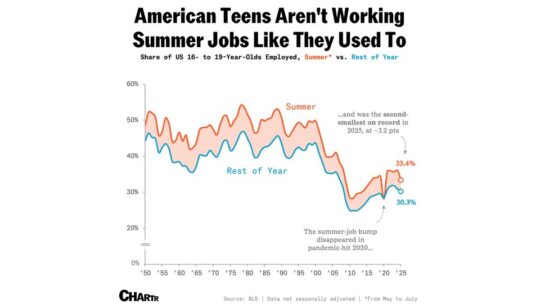
American Teens Aren’t Working Summer Jobs Like They Used To
DisclosureThis material is for general information only and is not intended to provide specific advice or recommendations for any individual.…