
Using a ROTH IRA for College Savings
Let’s face it, the importance of a college education in today’s society is no big secret. In 2017, some 20.4 million students attended American colleges and universities, an increase of about 5.1 million since fall 2000[i].
There has been a 30% increase in college attendance from 2000 to today. And as the law of supply and demand tells us: as demand for a product increases, so does the price.
Since 1995:
- The average tuition and fees at private National Universities jumped 179%.
- Out-of-state tuition and fees at public universities rose 226%.
- In-state tuition and fees at public National Universities grew the most, increasing a staggering 296%[ii].
Knowing the importance of education in our society, a large part of the financial planning process for many American families is how to cover these costs and find the most effective way to save for education expenses.
The traditional methods to put away money for our children’s futures are Uniform Transfer to Minors Act (UTMA) Accounts, Savings, Bonds, or college savings specific accounts such as Coverdell ESA’s and 529 Savings Plans. One option that is often overlooked by many families is a Roth IRA. YES, a ROTH IRA!
“But Matt, isn’t a ROTH IRA a retirement account?”
While yes, the Roth IRA is technically a retirement account, it has some characteristics that can also make it an effective way to save for college. At first glance, a Roth IRA might seem an unusual college savings vehicle. Upon further examination, it may look like a particularly smart choice.
Here is how it works.
Roth IRAs enjoy a rather unique tax treatment.
Withdrawals from contributory Roth IRAs are treated as a “return of contribution” first and as earnings second. This means that a person who has been contributing $5,000 per year for the past five years can withdraw $25,000 tax-free, provided the proceeds are used for qualified educational expenses. (Any withdrawals that exceed the total of one’s contributions and are attributable to earnings will be taxable for those under age 59½.)[i]
A Roth IRA allows you to save for college without the constraints of a college fund.
This is an important distinction, because you cannot predict everything about your child’s educational future. What if your child decides not to go to college? Or, what if you save for years with the goal of paying tuition at an elite school and then a great university steps forward to offer your child a major scholarship or a full ride?
What many don’t know is that if you take funds out of traditional college savings plans such as Coverdell ESA or 529 college savings plans and use them for anything but qualified education expenses, an income tax bill may result, plus a possible 10% Internal Revenue Service penalty on account earnings. (The 10% penalty is waived for 529 plan beneficiaries who get scholarships.)[ii]
One possible advantage of the ROTH IRA is if your child gets a scholarship, elects not to attend college, or goes to a cheaper college than you anticipated, you still have an invested, tax-advantaged account left to use for your retirement, with the potential to withdraw 100% of it, tax free.[iii]
You can withdraw Roth IRA contributions at any time, for any reason, without incurring taxes or penalties. When you are an original owner of a Roth IRA and you are age 59½ or older, you can withdraw your Roth IRA’s earnings, tax free, so long as the IRA has existed for five years. From a college savings standpoint, all this is great: parents 60 and older who have owned a Roth for at least five years may draw it down without any of that money being taxed, and younger parents may withdraw at least part of the money in a Roth IRA, tax free.[iv]
You probably know that the I.R.S. discourages withdrawals of Roth IRA earnings before age 59½ with a 10% early withdrawal penalty.
This penalty is not assessed, however, if the early withdrawal is used for qualified higher education expenses (i.e. Tuition, Books etc.). Occasionally, parents roll over money from workplace retirement plans into Roth IRAs to take advantage of this exemption.[v]
With a Roth IRA, your investment options are broad.
In contrast, many college savings plans such as the 529 give you only limited investment choices.
Admittedly, a Roth IRA is not a perfect college savings vehicle.
It has some drawbacks, and the big one is the annual contribution limit. You can currently contribute up to $5,500 to a Roth IRA per year, $6,500 per year if you are 50 or older. That pales in comparison to the limits for 529 college savings plans (though it certainly exceeds the yearly limit for Coverdell ESAs).[vi]
Some families earn too much money to open a Roth IRA. Joint filers, for example, cannot contribute to a Roth if they make in excess of $198,999 in 2018. There is a potential move around this obstacle: the so-called “backdoor Roth IRA.” You create a “backdoor Roth IRA” by rolling over assets from a traditional IRA into a Roth. That action has tax consequences, and once the rollover is made, you are prohibited from putting the assets back into the traditional IRA.
Lastly, there is a bit of an impact on financial aid prospects. When funds are distributed from a Roth IRA and used to pay for college costs, those distributions are defined as untaxed income on the Free Application for Federal Student Aid (FAFSA). Fortunately, the total asset value of the Roth IRA is not reported on the FAFSA.
Roth IRAs may help families who want to save for retirement and college. If you already have a good start on retirement savings and want to open one with the intention of using it as a college fund, it may be a superb idea. If you like the potential of having tax-free retirement income and may need a little more college funding for your kids, it may be a good idea as well.
YOUR REASON
The decision on what strategy to use for college planning is different for every family. Reason Financial is your team of highly specialized professionals in college savings planning here to help you navigate and design the best strategy for you.
Enabling you and your family to make a lifetime of rational, informed and well-reasoned financial decisions gives us purpose in what we do. Thank you for your continued trust.
[i] https://www.cnbc.com/2014/02/03/roth-iras-can-be-a-better-way-to-save-pay-for-higher-education-costs.html[2/3/14]
[ii] fool.com/retirement/2018/03/25/3-reasons-not-to-rely-on-529-plans.aspx [3/25/18]
[iii] tinyurl.com/yd4mjdbh [3/28/18]
[iv] investor.vanguard.com/ira/roth-ira [4/17/18]
[v] budgeting.thenest.com/can-use-rollover-ira-finance-sons-college-education-23928.html [4/17/18]
[vi] thebalance.com/is-it-okay-to-use-a-roth-ira-to-pay-for-college-expenses-4009940 [1/31/18]
[i] Nces.ed.gov/fastfacts/display.asp?id=372
[ii] https://www.usnews.com/education/best-colleges/paying-for-college/articles/2015/07/29/chart-see-20-years-of-tuition-growth-at-national-universities [7/20/17]
Disclosure
This material is for general information only and is not intended to provide specific advice or recommendations for any individual. There is no assurance the views or strategies discussed are suitable for all investors or will yield positive outcomes. Investing involves risks including possible loss of principal. Any company names noted herein are for educational purposes only.
All information is believed to be from reliable sources; however we make no representation as to its completeness or accuracy. All economic and performance data is historical and not indicative of future results. Market indices discussed are unmanaged. Investors cannot invest in unmanaged indices. Additional risks are associated with international investing, such as currency fluctuations, political and economic instability and differences in accounting standards.
Investing in securities in emerging markets involves special risks due to specific factors such as increased volatility, currency fluctuations and differences in auditing and other financial standards. Securities in emerging markets are volatile and can decline significantly in response to adverse issuer, political, regulatory, market, or economic developments.
An index is a statistical measure of change in an economy or a securities market. In the case of financial markets, an index is an imaginary portfolio of securities representing a particular market or a portion of it. Each index has its own calculation methodology and is usually expressed in terms of a change from a base value. Thus, the percentage change is more important than the actual numeric value. An investment cannot be made directly into an index.
Investing in fixed income securities involves credit and interest rate risk. When interest rates rise, bond prices generally fall. Investing in commodities may involve greater volatility and is not suitable for all investors. Investing in a non-diversified fund that concentrates holdings into fewer securities or industries involves greater risk than investing in a more diversified fund. The equity securities of small companies may not be traded as often as equity securities of large companies so they may be difficult or impossible to sell. Neither diversification nor asset allocation assure a profit or protect against a loss in declining markets. Past performance is not an indicator of future results.
Financial Planning offered through Reason Financial, a state Registered Investment Advisor. Investment advice offered through Merit Financial Group, LLC an SEC Registered Investment Advisor. Merit Financial Group and Reason Financial are separate entities. Tax related services offered through Reason Tax Group. Reason Tax Group is a separate legal entity and not affiliated with Merit Financial Group, LLC. Sean P. Storck CA Insurance Lic#OF25995 and Steven W. Pollock CA Insurance Lic#OE98073
Copyright © 2026 Reason Financial all rights reserved.
Continue Reading

3rd Quarter 2026 – Economic and Market Update
Q2 2026 in review: the S&P 500’s best quarter since 2020, oil’s round trip from $114 back to $70, a 4.2% CPI print that would not quit, and a new Fed chair who took 2026 rate cuts off the table — plus what a 15% quarter means for the allocation you actually own.

America at 250: A Birthday Worth Sitting With for a Moment
The United States just turned 250 — and the story reads surprisingly well as a series of 50-year check-ins. Founding-era population the size of San Diego County, two presidents with impeccable dramatic timing, a telephone demo in Philadelphia, quarters you’re still finding in your change — and one compounding machine that started counting in 1926.
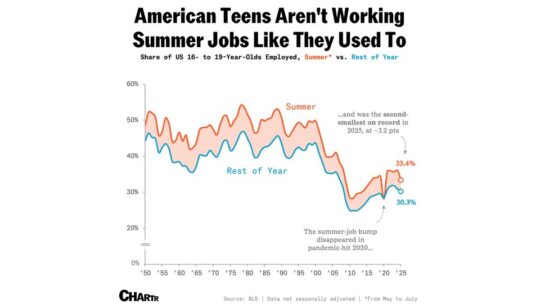
American Teens Aren’t Working Summer Jobs Like They Used To
DisclosureThis material is for general information only and is not intended to provide specific advice or recommendations for any individual.…