
What is Probate?
Many of our clients don’t know what probate is, and that is probably a good thing. Probate is the legal process by which a will is validated. If there’s no will, it’s the legal process of settling a person’s affairs.
How probate works
The process, when required, varies by state. In some states (like California) probate is automatic, involving a number of steps from getting a death certificate, to identifying an executor or administrator for the estate, to identifying assets, paying expenses like debt or taxes, and notifying or paying beneficiaries. If there is a will, the judge also validates the will. (For a will to be valid, it usually has to have witnesses. Sometimes, the witnesses must appear at probate, and sometimes they can sign an affidavit at the same time the will is signed instead.)
When there is a will in place, it usually identifies the executor, assets, and beneficiaries, as well as any outstanding debts and obligations. This can make the probate process much easier. However, it’s also possible that someone may contest the will. A child may object if a new spouse is named as executor, for example.
The executor’s job
How involved the job of an executor depends on the estate. While the executor may be named in the will, and be someone related to the deceased, an executor may also be a professional or appointed by the court.
It is an executor’s job to take stock of the decedent’s assets, including any that aren’t listed or disclosed in the will. In most cases, this is a simple process, particularly if the deceased individual had an estate plan in place.
The executor is also responsible for taking control of any assets during the probate process, in order to protect those assets, especially if there ends up being any kind of dispute. The executor may be responsible for hiring an appraiser to look at the “death value” of certain assets, though sometimes the court will appoint an appraiser independent of the executor.
In addition to gathering assets, the executor must also notify any creditors that a death has occurred. This includes the bank (if the deceased had a mortgage), and can also include publishing an obituary so that any unknown creditors have an opportunity to come forward.
Finally, the executor must resolve the estate. This includes paying off debts (and challenging any they view as unfair) and divvying up assets to the beneficiaries. If the will specifies assets go to minors, the executor may be instructed to set up a trust for those assets.
Who pays for probate?
As you can imagine, the probate process can take time to complete and may require lawyers, court appearances, or both. If this occurs, the legal fees are generally paid from the estate.
The process can go relatively quickly, but it’s not uncommon for it to take up to a year. In some cases, immediate family members who are beneficiaries can ask the court to release funds during the probate period. (For instance, you might ask a probate judge to be reimbursed for funeral expenses before the estate is settled.)
Intestate
If there is no valid will (either because the decedent did not prepare one, or because the court rules the will invalid) the estate is said to be “intestate.”
In this case, any assets left over after debts are paid go to the closest living relative. Who that relative is may vary depending on state law and personal circumstances.
Avoiding probate
While having a will can facilitate probate, it doesn’t get you out of the process. However, some assets that are exempt from probate. For instance, some property passes outside of probate, notably life insurance policies, trusts, jointly owned property, and payable-on-death accounts. (Most retirement accounts fall under this category, too, if you’ve named a beneficiary).
If you want to avoid the probate process and protect your financial details from becoming a part of the public record, consider creating an estate plan that includes a trust. There will still be details to take care of to settle your affairs, but those will fall to whomever you named trustee, versus your executor (though many times this is the same person.)
We at Reason Financial can talk through the details, including what options might make sense for you and your family, when we build your Estate Plan.
Content in this material is for general information only and is not intended to provide specific advice or recommendations for any individual. This information is not intended to be a substitute for individualized legal advice. Reason Financial and LPL Financial do not provide legal advice or services. Please consult your legal advisor regarding your specific situation
Sources: PolicyGenius, the balance, NOLO, Investopedia
Disclosure
This material is for general information only and is not intended to provide specific advice or recommendations for any individual. There is no assurance the views or strategies discussed are suitable for all investors or will yield positive outcomes. Investing involves risks including possible loss of principal. Any company names noted herein are for educational purposes only.
All information is believed to be from reliable sources; however we make no representation as to its completeness or accuracy. All economic and performance data is historical and not indicative of future results. Market indices discussed are unmanaged. Investors cannot invest in unmanaged indices. Additional risks are associated with international investing, such as currency fluctuations, political and economic instability and differences in accounting standards.
Investing in securities in emerging markets involves special risks due to specific factors such as increased volatility, currency fluctuations and differences in auditing and other financial standards. Securities in emerging markets are volatile and can decline significantly in response to adverse issuer, political, regulatory, market, or economic developments.
An index is a statistical measure of change in an economy or a securities market. In the case of financial markets, an index is an imaginary portfolio of securities representing a particular market or a portion of it. Each index has its own calculation methodology and is usually expressed in terms of a change from a base value. Thus, the percentage change is more important than the actual numeric value. An investment cannot be made directly into an index.
Investing in fixed income securities involves credit and interest rate risk. When interest rates rise, bond prices generally fall. Investing in commodities may involve greater volatility and is not suitable for all investors. Investing in a non-diversified fund that concentrates holdings into fewer securities or industries involves greater risk than investing in a more diversified fund. The equity securities of small companies may not be traded as often as equity securities of large companies so they may be difficult or impossible to sell. Neither diversification nor asset allocation assure a profit or protect against a loss in declining markets. Past performance is not an indicator of future results.
Financial Planning offered through Reason Financial, a state Registered Investment Advisor. Investment advice offered through Merit Financial Group, LLC an SEC Registered Investment Advisor. Merit Financial Group and Reason Financial are separate entities. Tax related services offered through Reason Tax Group. Reason Tax Group is a separate legal entity and not affiliated with Merit Financial Group, LLC. Sean P. Storck CA Insurance Lic#OF25995 and Steven W. Pollock CA Insurance Lic#OE98073
Copyright © 2026 Reason Financial all rights reserved.
Continue Reading
3rd Quarter 2026 – Economic and Market Update
Q2 2026 in review: the S&P 500’s best quarter since 2020, oil’s round trip from $114 back to $70, a 4.2% CPI print that would not quit, and a new Fed chair who took 2026 rate cuts off the table — plus what a 15% quarter means for the allocation you actually own.
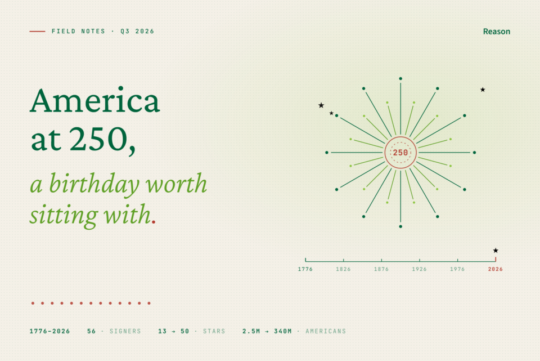
America at 250: A Birthday Worth Sitting With for a Moment
The United States just turned 250 — and the story reads surprisingly well as a series of 50-year check-ins. Founding-era population the size of San Diego County, two presidents with impeccable dramatic timing, a telephone demo in Philadelphia, quarters you’re still finding in your change — and one compounding machine that started counting in 1926.
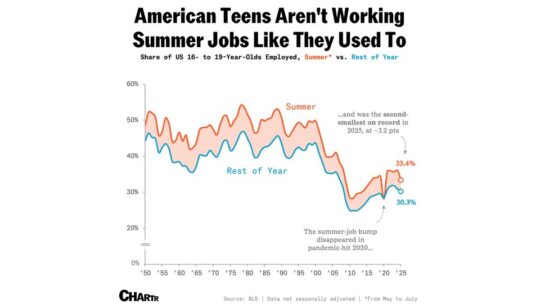
American Teens Aren’t Working Summer Jobs Like They Used To
This Chartr line chart tracks the share of U.S. 16- to 19-year-olds who were employed from 1950 through 2025, split…